
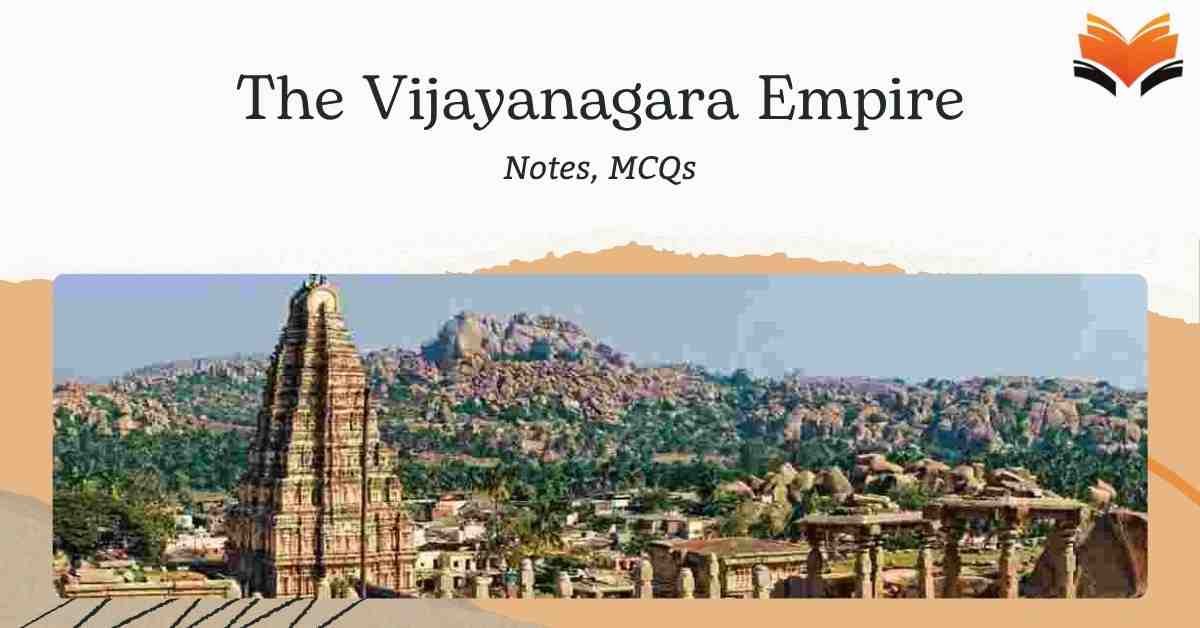
The Vijayanagara Empire was established in the 14th century by Harihara and Bukka Raya in southern India after they rejected Delhi Sultanate’s authority. Its major rival was the Bahmani Sultanate and later the Deccan Sultanates. The empire reached its peak under Krishnadevaraya in the 16th century, who strengthened the empire, promoted trade, literature, art and temple building. Vijayanagara became a prosperous centre with grand temples, palaces and busy markets. In 1565, the Deccan Sultanates defeated Vijayanagara at the Battle of Talikota and destroyed its capital. The empire later fragmented under the Nayakas and ended in the mid-17th century.
The Vijayanagara Empire
1. Rise of the Vijayanagara Empire:
- While the Delhi Sultanate became increasingly politically unstable, a new centre of power emerged in southern India.
- In the 14th century, two brothers, Harihara and Bukka Raya, played an important role in establishing this new power.
- Harihara and Bukka Raya had initially served as governors under Muhammad bin Tughlaq.
- They later rejected the authority of Delhi.
- They established an independent kingdom in southern India.
- This kingdom became a significant political force in the south and developed into the Vijayanagara Empire.
2. Bahmani Sultanate as a Major Rival:
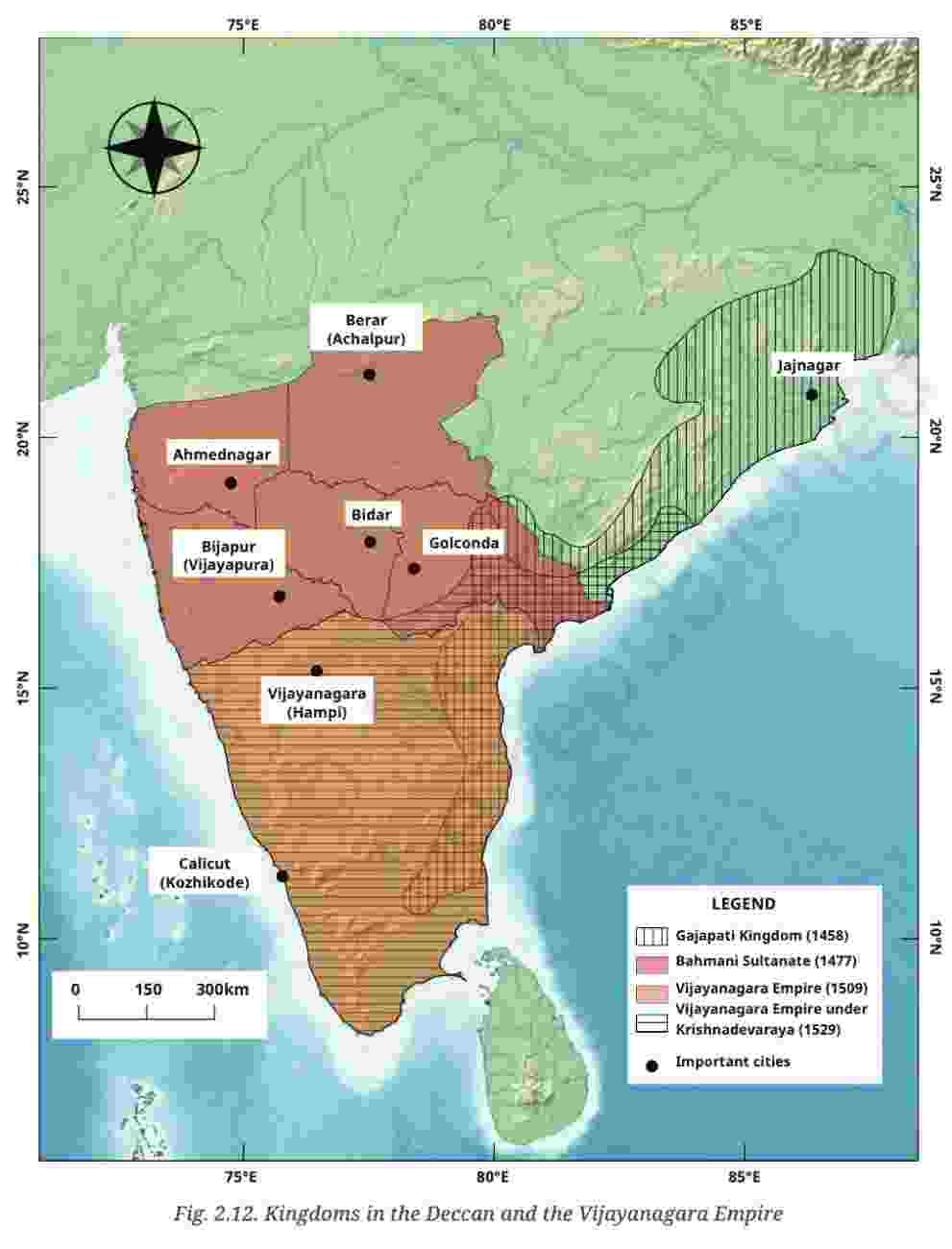
- The Bahmani Sultanate was located to the north of the Vijayanagara Empire.
- It emerged as a major rival of Vijayanagara.
- The Bahmani Sultanate eventually fragmented into five independent states, collectively known as the Deccan Sultanates.
- The five Deccan Sultanates were:
- Bijapur
- Golconda
- Berar
- Ahmednagar
- Bidar
- These states were ruled by former governors or tarafdars who had declared their autonomy.
3. Conflicts of the Vijayanagara Empire:
- The Vijayanagara rulers fought against the Deccan Sultanates.
- They particularly battled with Bijapur and Golconda.
- Vijayanagara also fought the Gajapati rulers of Odisha in the east.
- Thus, the Vijayanagara Empire faced important rivals both to its north and east.
4. Folklore about the Foundation of Hampi:
- According to popular folklore, Harihara and Bukka witnessed a remarkable incident at Hampi, in present-day Karnataka.
- They saw a hare turn around and chase a pack of hounds.
- This unusual incident was seen as a symbol of unexpected strength and courage.
- They narrated the incident to their guru, Vidyaranya.
- Vidyaranya interpreted the incident as a symbol of resilience and bravery.
- He advised Harihara and Bukka to establish their capital at that very place.
Krishnadevaraya
1. Krishnadevaraya and the Peak of Vijayanagara:
- In the 16th century, the Vijayanagara Empire reached its peak under Krishnadevaraya.
- Krishnadevaraya was a celebrated ruler of the Vijayanagara Empire.
- He expanded and secured the empire’s dominance over the Deccan.
- Under his rule, the empire achieved:
- Military power
- Cultural renaissance
2. Patronage of Literature and Scholars:
- Krishnadevaraya patronised poets and scholars in:
- Sanskrit
- Telugu
- Kannada
- He himself composed an epic poem in Telugu called Āmuktamālyada.
- Āmuktamālyada tells the story of the Tamil poet-saint Āṇḍāl.
- One section of the work is called Rājanīti, meaning royal policy.
- In Rājanīti, Krishnadevaraya explained his ideas about good governance.
3. Temple Patronage and Architecture:
- Krishnadevaraya provided grants to many temples.
- Important temples mentioned in the text include:
- Tirupati in Andhra Pradesh
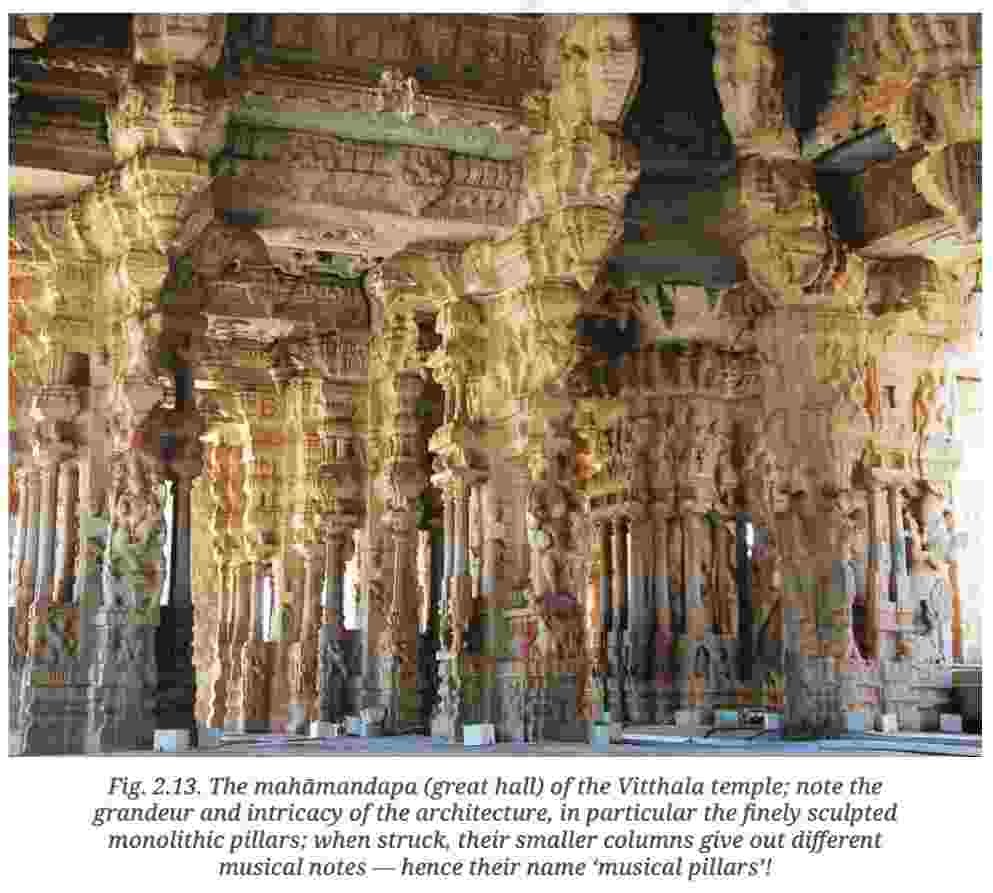
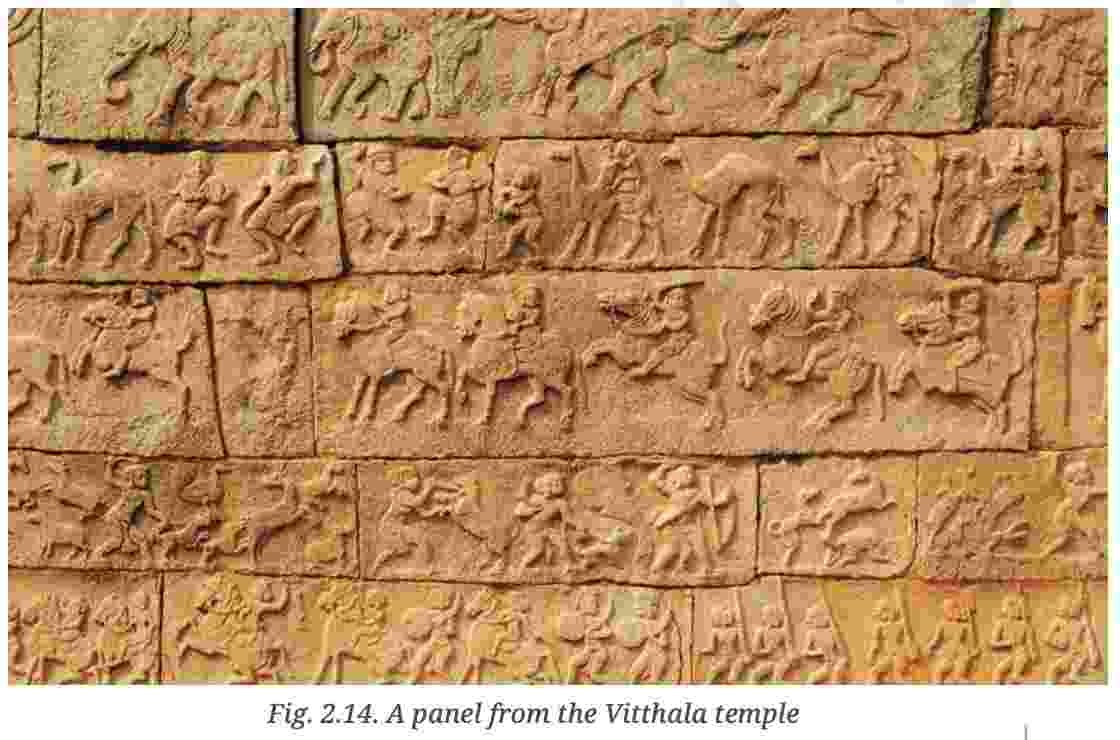
- Vitthala Temple in his capital, Vijayanagara
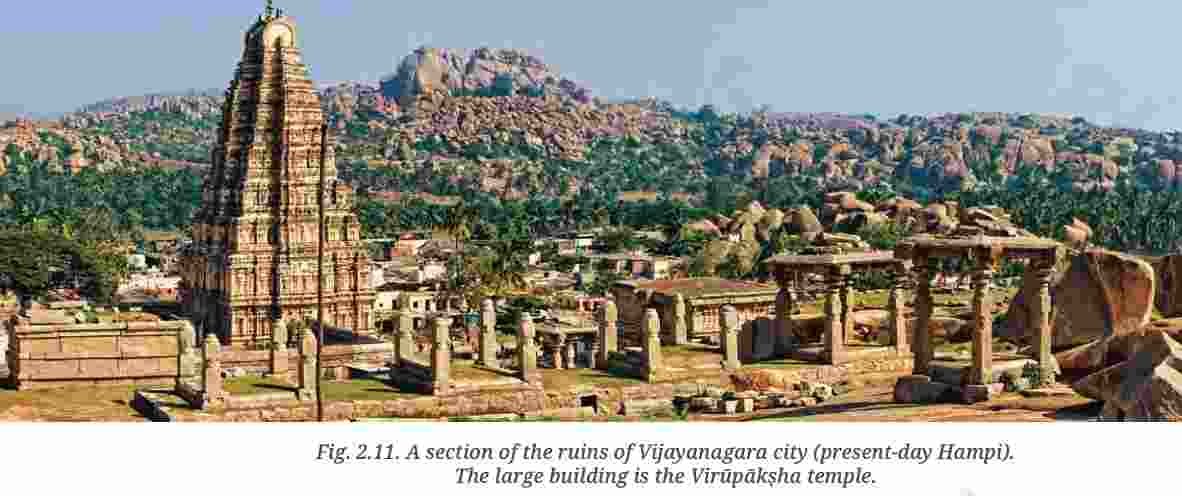
- Vijayanagara displayed many grand temples, palaces and other buildings.
4. Death of Krishnadevaraya:
- Krishnadevaraya won many wars against his neighbours.
- He died of illness in 1529.
5. Battle of Talikota and Fall of Vijayanagara:
- In 1565, the Deccan Sultanates formed a coalition against Vijayanagara.
- They defeated the Vijayanagara forces led by Ramaraya, who was Krishnadevaraya’s son-in-law.
- The defeat took place at the Battle of Talikota.
- After the battle, the city of Vijayanagara was sacked for several months.
- During the destruction:
- Houses were destroyed.
- Shops were destroyed.
- Buildings were destroyed.
- Palaces were destroyed.
- Most temples were destroyed.
- Much of the civilian population was massacred.
- The city was ultimately left in ruins.
- After the destruction, the Vijayanagara Empire became fragmented into smaller regions.
- These regions were ruled by Nayakas, who had previously been military governors.
- The Vijayanagara Empire came to an end in the mid-17th century.
6. Foreign Travellers and Vijayanagara:
- Foreign travellers visited Vijayanagara for trade.
- Portuguese travellers were particularly well treated.
- Portuguese traders came to sell horses.
- The king did not want them to sell these valuable horses to enemy kingdoms.
- Domingo Paes, a Portuguese traveller, left a long and detailed account of his stay in the Vijayanagara capital.
- According to Paes, Vijayanagara:
- Appeared to him as large as Rome.
- Was very beautiful.
- Had many groves of trees and gardens.
- Had many water conduits and lakes.
- Had a very large population.
- Was well supplied with everything.
- Had busy streets and markets.
- Had laden oxen in its streets and markets.
- Offered a great abundance of goods.
The Vijayanagara Empire: Exam & Revision Summary
The Vijayanagara Empire emerged in the 14th century in southern India when brothers Harihara and Bukka Raya, who had earlier served as governors under Muhammad bin Tughlaq, rejected Delhi’s authority and established an independent kingdom. It became a major political power in southern India.
The Bahmani Sultanate was its major rival in the north. It later divided into five Deccan Sultanates: Bijapur, Golconda, Berar, Ahmednagar and Bidar. Vijayanagara fought against Bijapur and Golconda, as well as the Gajapati rulers of Odisha.
According to popular folklore, Harihara and Bukka saw a hare chasing hounds at Hampi, which symbolised courage and resilience. Their guru Vidyaranya interpreted the event as a sign that they should establish their capital there.
Krishnadevaraya and the Peak of Vijayanagara
The empire reached its peak in the 16th century under Krishnadevaraya. He strengthened the empire’s military power and secured its dominance over the Deccan. His reign was also known for a cultural renaissance.
Krishnadevaraya supported poets and scholars in Sanskrit, Telugu and Kannada. He himself wrote the Telugu epic Āmuktamālyada, based on the story of the Tamil poet-saint Āṇḍāl. It also contained a section called Rājanīti, in which he discussed ideas of good governance.
He gave grants to several temples, including Tirupati and the Vitthala temple at Vijayanagara. The capital was known for its grand temples, palaces and other buildings.
Battle of Talikota and Decline
Krishnadevaraya died of illness in 1529. In 1565, the Deccan Sultanates united and defeated the Vijayanagara army led by Ramaraya, Krishnadevaraya’s son-in-law, in the Battle of Talikota.
After the battle, Vijayanagara was sacked for several months. Houses, shops, buildings, palaces and most temples were destroyed, and much of the civilian population was massacred. The city was left in ruins.
The empire subsequently fragmented into smaller regions ruled by Nayakas, who were former military governors. The Vijayanagara Empire finally came to an end in the mid-17th century.
Foreign Travellers and Vijayanagara
Foreign travellers visited Vijayanagara mainly for trade. Portuguese travellers received special treatment because they supplied horses, which the king did not want them to sell to enemy kingdoms.
The Portuguese traveller Domingo Paes described Vijayanagara as a very large and beautiful city, with gardens, water channels, lakes, crowded streets, markets and abundant goods. His account highlights the city’s prosperity and impressive urban life.
Quick Revision Points
- 14th century: Vijayanagara Empire established by Harihara and Bukka Raya.
- Capital: Vijayanagara, associated with Hampi.
- Major rival: Bahmani Sultanate and later the Deccan Sultanates.
- Greatest ruler: Krishnadevaraya.
- Famous work: Āmuktamālyada.
- Important section: Rājanīti on good governance.
- 1565: Battle of Talikota.
- After Talikota: Empire fragmented under Nayakas.
- End: Mid-17th century.
- Important foreign traveller: Domingo Paes.
MCQs on NCERT Social Science Class 8 Chapter 2 Topic – The Vijayanagara Empire
Question 1. Who established the kingdom that later became the Vijayanagara Empire?
A. Krishnadevaraya and Ramaraya
B. Harihara and Bukka Raya
C. Ala-ud-din Khilji and Malik Kafur
D. Rana Kumbha and Narasimhadeva I
Answer: B. Harihara and Bukka Raya
Question 2. Harihara and Bukka Raya initially served as governors under:
A. Ala-ud-din Khilji
B. Muhammad bin Tughlaq
C. Krishnadevaraya
D. Rana Kumbha
Answer: B. Muhammad bin Tughlaq
Question 3. What did Harihara and Bukka Raya do after rejecting Delhi’s authority?
A. Established an independent kingdom in southern India
B. Joined the Bahmani Sultanate
C. Established the Delhi Sultanate
D. Became governors of Odisha
Answer: A. Established an independent kingdom in southern India
Question 4. Which Sultanate was a major rival of the Vijayanagara Empire?
A. Mamluk Sultanate
B. Bahmani Sultanate
C. Lodi Sultanate
D. Sayyid Sultanate
Answer: B. Bahmani Sultanate
Question 5. Into how many independent states did the Bahmani Sultanate eventually fragment?
A. Three
B. Four
C. Five
D. Six
Answer: C. Five
Question 6. Which of the following was not one of the five Deccan Sultanates?
A. Bijapur
B. Golconda
C. Berar
D. Vijayanagara
Answer: D. Vijayanagara
Question 7. According to popular folklore, what unusual event at Hampi inspired Harihara and Bukka?
A. A lion defeating an army
B. A hare turning around and chasing a pack of hounds
C. A horse defeating a tiger
D. An elephant defeating a lion
Answer: B. A hare turning around and chasing a pack of hounds
Question 8. Who interpreted the incident at Hampi as a symbol of resilience and bravery?
A. Krishnadevaraya
B. Ramaraya
C. Vidyaranya
D. Domingo Paes
Answer: C. Vidyaranya
Question 9. Under which ruler did the Vijayanagara Empire reach its peak in the 16th century?
A. Harihara
B. Bukka Raya
C. Krishnadevaraya
D. Ramaraya
Answer: C. Krishnadevaraya
Question 10. Which of the following best describes Krishnadevaraya’s contribution to the Vijayanagara Empire?
A. He weakened the empire through continuous defeats
B. He expanded and secured the empire’s dominance and promoted cultural development
C. He established the Bahmani Sultanate
D. He ended all cultural activities
Answer: B. He expanded and secured the empire’s dominance and promoted cultural development
Question 11. Which languages were patronised by Krishnadevaraya?
A. Sanskrit, Telugu and Kannada
B. Tamil, Persian and Arabic
C. Hindi, Bengali and Marathi
D. Sanskrit, Urdu and Malayalam
Answer: A. Sanskrit, Telugu and Kannada
Question 12. Which work was composed by Krishnadevaraya in Telugu?
A. Rajatarangini
B. Āmuktamālyada
C. The Motion
D. De revolutionibus
Answer: B. Āmuktamālyada
Question 13. What happened at the Battle of Talikota in 1565?
A. Vijayanagara defeated the Deccan Sultanates
B. The Deccan Sultanates defeated the Vijayanagara forces led by Ramaraya
C. Krishnadevaraya defeated the Bahmani Sultanate
D. The Delhi Sultanate conquered Vijayanagara
Answer: B. The Deccan Sultanates defeated the Vijayanagara forces led by Ramaraya
Question 14. What happened to the Vijayanagara Empire after the Battle of Talikota?
A. It immediately became stronger
B. It was fragmented into smaller regions ruled by Nayakas
C. It conquered the Deccan Sultanates
D. It shifted its capital to Delhi
Answer: B. It was fragmented into smaller regions ruled by Nayakas
Question 15. Why were Portuguese travellers particularly well treated in Vijayanagara?
A. They came to teach Sanskrit
B. They came to sell horses, which were valuable for the kingdom’s military needs
C. They came to build temples
D. They were rulers of Vijayanagara
Answer: B. They came to sell horses, which were valuable for the kingdom’s military needs
Next & Previous Topics of NCERT/CBSE Social Science Class 8 Chapter 2: Reshaping India’s Political Map
| Topics No. | Topics Name |
|---|---|
| 1 | Rise and Fall of The Delhi Sultanate |
| 2 | The Vijayanagara Empire |
| 3 | The Mughals |
| 4 | Resistance to the Mughals |
| 5 | Administering India |
| 6 | People’s Lives |
FAQs on The Vijayanagara Empire Class 8 Social Science
1. Who founded the Vijayanagara Empire?
Answer: The Vijayanagara Empire was established in the 14th century by two brothers, Harihara and Bukka Raya. They had initially served as governors under Muhammad bin Tughlaq but later rejected Delhi’s authority and established an independent kingdom in southern India.
2. Who was Krishnadevaraya? Why is he important in the history of the Vijayanagara Empire?
Answer: Krishnadevaraya was the celebrated ruler under whom the Vijayanagara Empire reached its peak in the 16th century. He expanded and secured the empire’s dominance over the Deccan and promoted military power, literature, scholarship, temples and cultural activities.
3. What were the cultural contributions of Krishnadevaraya?
Answer: Krishnadevaraya patronised poets and scholars in Sanskrit, Telugu and Kannada. He composed the Telugu epic Āmuktamālyada, which included ideas about good governance. He also gave grants to temples such as Tirupati and the Vitthala temple in Vijayanagara.
4. What was the Battle of Talikota and what was its result?
Answer: The Battle of Talikota was fought in 1565 between the Vijayanagara forces led by Ramaraya and a coalition of the Deccan Sultanates. The Vijayanagara forces were defeated, after which the city was sacked for several months and left in ruins.
5. Why did the Vijayanagara Empire decline after the Battle of Talikota?
Answer: After the Battle of Talikota, the city of Vijayanagara was sacked, and its houses, shops, buildings, palaces and most temples were destroyed. Much of the civilian population was massacred. The empire then fragmented into smaller regions ruled by Nayakas, who were former military governors.
6. What role did foreign travellers play in the history of the Vijayanagara Empire?
Answer: Foreign travellers visited Vijayanagara for trade and left detailed accounts of the empire. Domingo Paes, a Portuguese traveller, described the city as very large and beautiful, with gardens, water channels, lakes, crowded streets and markets filled with goods and traders. Foreign travellers’ accounts are important sources for understanding Vijayanagara.