
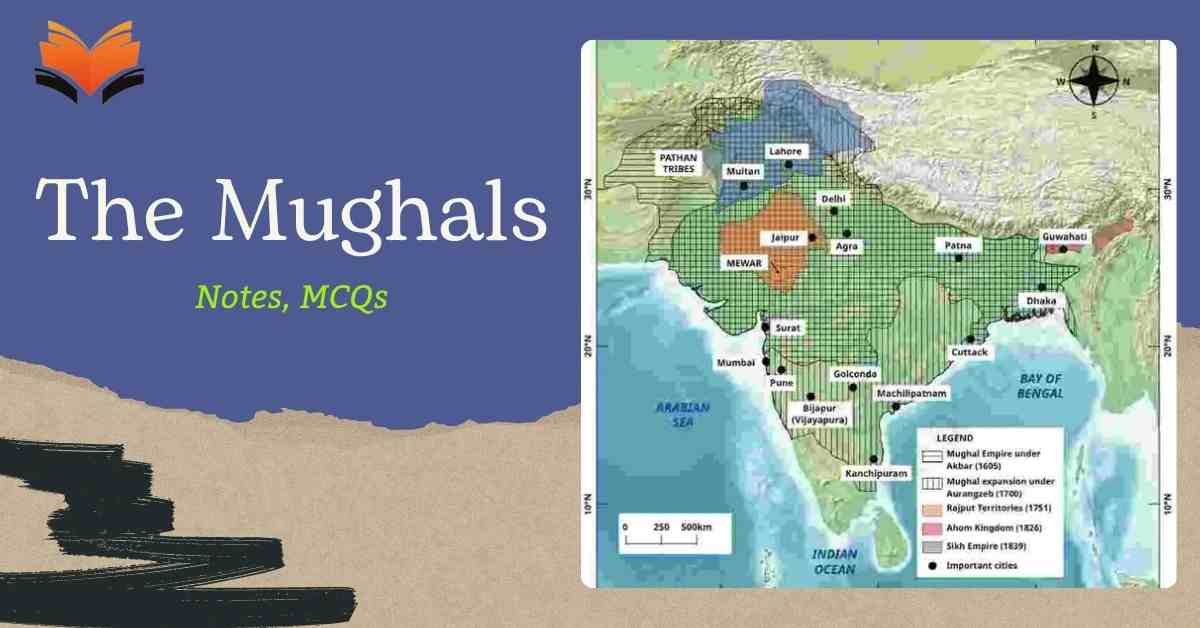
The Mughal Empire was founded by Babur after his victory over Ibrahim Lodi in the First Battle of Panipat in 1526. After Humayun and the brief rule of Sher Shah Suri, Akbar greatly expanded and strengthened the empire through military conquests and policies of tolerance, including abolishing jizya and promoting sulh-i-kul. Jahangir and Shah Jahan continued Mughal cultural and architectural achievements, including the Taj Mahal. Aurangzeb expanded the empire to its greatest extent but faced prolonged Deccan wars, religious conflicts and financial strain. After his death in 1707, Mughal power rapidly declined.
The Mughals
1. Babur and the Foundation of the Mughal Empire:
- Babur was a Turkic–Mongol ruler and military strategist.
- After being driven out of Samarkand, Babur turned his attention towards India.
- Babur was a descendant of Timur.
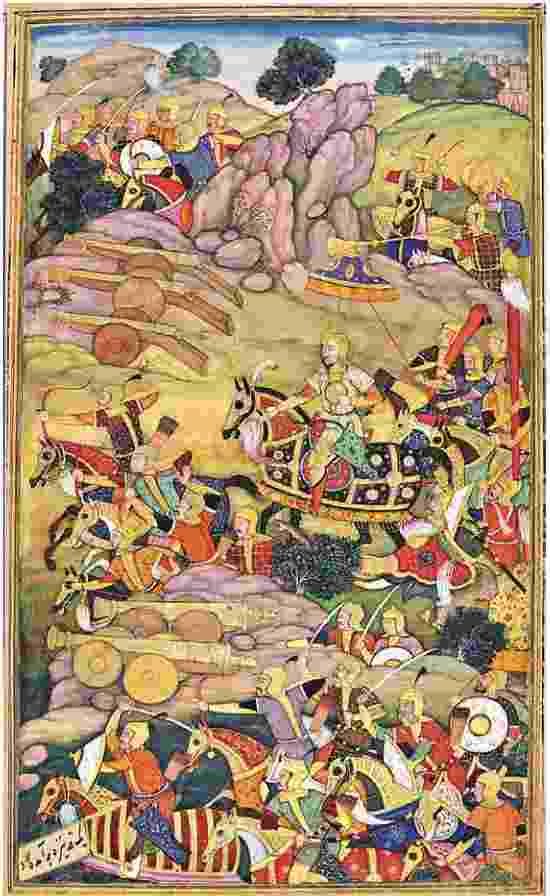
- In 1526, Babur defeated Ibrahim Lodi at Panipat.
- This battle came to be known as the First Battle of Panipat.
- Babur’s victory brought the Delhi Sultanate to a final end.
- After the victory, Babur assumed control of the Delhi throne.
- The victory at Panipat laid the foundation of the Mughal Empire.
- The First Battle of Panipat relied heavily on gunpowder, field artillery and matchlock guns.
- These forms of warfare had been recently introduced in India.
2. Humayun and the Sur Empire:
- After Babur’s death in 1530, his son Humayun struggled to hold the Mughal Empire together.
- Taking advantage of Humayun’s difficulties, Sher Shah Suri, a powerful Afghan leader, established the Sur Empire.
- The Sur Empire controlled large parts of northern India.
- Sher Shah Suri introduced many lasting reforms.
- The Sur Empire was short-lived.
- Humayun soon reconquered the territories that had been lost.
3. Himu and the Second Battle of Panipat:
- Himu (Hemu) was a skilled military commander and chief minister or wazir under one of the last Suri rulers.
- Himu captured Delhi and ruled it briefly.
- He ruled under the royal name Hemchandra Vikramaditya.
- Himu achieved some military successes.
- He was later confronted by Akbar, Babur’s grandson, at the Second Battle of Panipat.
- Himu was injured on the battlefield.
- He was captured and brought before Akbar.
- Akbar had Himu beheaded.
- Akbar soon reclaimed Delhi for the Mughals.
4. Baburnama:
- Babur left behind an autobiography called the Baburnama, or Babur’s Memoirs.
- The Baburnama is considered to be of great historical value.
- In it, Babur appears as cultured and intellectually curious.
- He showed a keen appreciation for:
- Architecture
- Poetry
- Animals, especially birds
- Flora, particularly fruit trees
5. Babur as a Conqueror:
- Despite his cultural interests, Babur was also described as a brutal and ruthless conqueror.
- He slaughtered entire populations of cities.
- He enslaved women and children.
- He took pride in erecting towers of skulls made from people killed in plundered cities.
6. Babur’s Views on India:
- Babur was nostalgic about Central Asia.
- He initially found India to be a country of few charms.
- At the same time, he recognised India’s:
- Large size
- Wealth in gold and silver
- Healthy and pleasant air during the rainy season
- Large number of artisans and workmen
- India’s wealth and resources helped persuade Babur to stay in India.
- Instead of returning to Central Asia, Babur decided to build his empire in India.
Akbar
1. Akbar’s Accession and Expansion:
- Akbar became emperor at the age of 13 after the accidental death of his father, Humayun.
- Akbar aimed to bring the entire Subcontinent under Mughal control.
- His reign combined brutality and tolerance, shaped by ambition and strategy.
- Akbar’s early conquests followed the examples of many of his predecessors.
2. Akbar’s Conquest of Chittor:
- Akbar besieged Chittor (Chittorgarh) in Rajasthan for more than five months.
- The Rajput soldiers offered determined resistance and inflicted heavy losses on the Mughal army.
- When the fort was finally breached, many Rajputs died fighting.
- Hundreds of women committed jauhar.
- Akbar ordered the massacre of about 30,000 civilians.
- The surviving women and children were enslaved.
- At the time of the Chittor conquest, Akbar was 25 years old.
- Akbar sent a message of victory claiming that forts and towns of the ‘infidels’ had been occupied and Islam established there.
- He also stated that temples had been destroyed in those places and elsewhere in Hindustan.
- Akbar believed that a monarch should remain focused on conquest, otherwise enemies would rise against him.
3. Political Strategies Used by Akbar:
- As Akbar’s empire expanded, he increasingly used political strategies to stabilise the empire.
- He entered into marriage alliances with princesses of neighbouring kingdoms.
- He welcomed Rajput and regional leaders into his court.
- He abolished the jizya.
- He promoted the doctrine of sulh-i-kul.
- Sulh-i-kul literally means ‘peace with all’ or tolerance of all faiths.
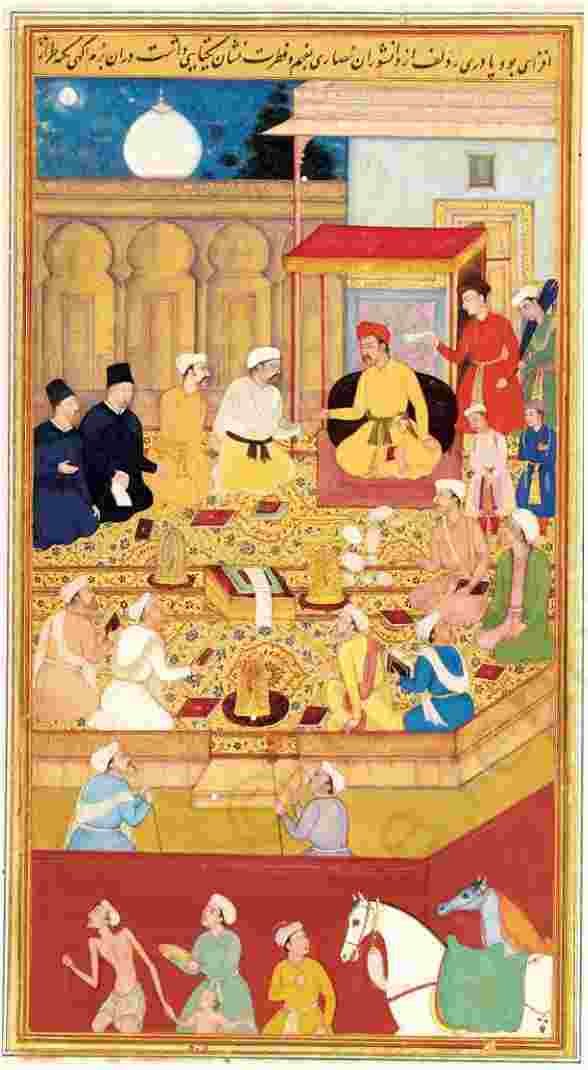
- Akbar encouraged interfaith dialogues.
- He appointed Hindu officials to high positions.
- These reforms helped Akbar expand and stabilise the Mughal Empire.
- Akbar gained the support of many Rajput rulers.
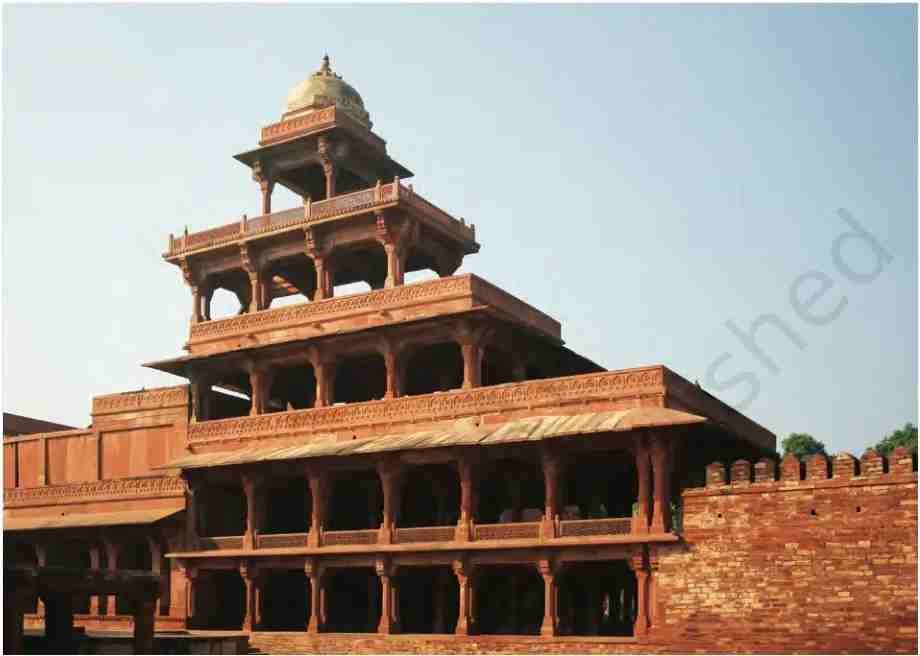
4. Akbar’s Change in Religious Outlook:
- Akbar’s religious outlook changed as he gained greater knowledge.
- According to his court historian and biographer Abul Fazl, Akbar later felt ashamed of having earlier persecuted people to make them conform to his faith.
- Akbar stated that it was inappropriate to force people to become Muslims.
- He also questioned the loyalty of people who converted under compulsion.
5. Akbar’s Reign:
- Akbar’s reign lasted for almost 50 years.
- His reign lasted from 1556 to 1605.
- The middle period of his reign was relatively peaceful.
- The final 15 years of his reign saw fresh military campaigns in:
- Kashmir
- Sindh
- Deccan
- Afghanistan
6. Akbar’s Interest in Knowledge and Literature:
- Although Akbar was illiterate, he became keen to explore Persian and Indian texts.
- He showed great interest in classical Indian thought.
- Akbar frequently invited scholars to his court.
- He established a ‘house of translation’ at Fatehpur Sikri.
- Major Sanskrit texts were translated into Persian.
- Important translated works included:
- Mahābhārata, called Razmnama or the ‘Book of War’ in Persian.
- Rāmāyaṇa, accompanied by 176 beautiful miniature paintings.
- Bhagavad Gita
- Pañchatantra
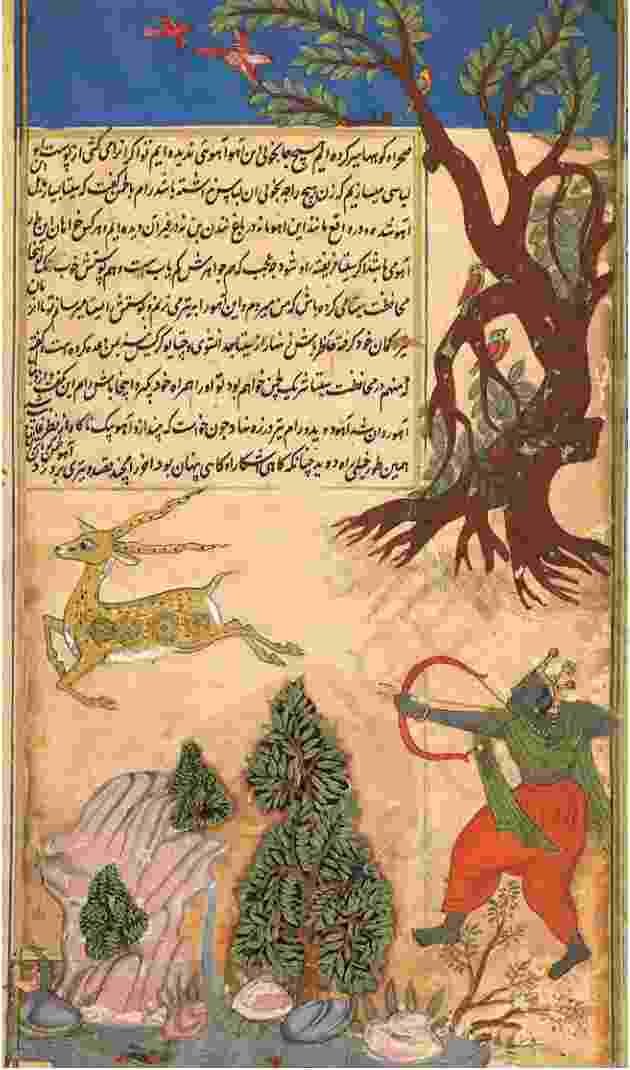
7. Mughal Art, Architecture and Culture:
- Jahangir
- Jahangir, Akbar’s son, shared his father’s love for art and architecture.
- He attempted to expand the Mughal Empire into the Deccan.
- Shah Jahan
- Shah Jahan, Jahangir’s son, fought several rebellions.
- He is best remembered as the builder of the Taj Mahal at Agra.
- The Taj Mahal is recognised as one of the great architectural marvels of the world.
- Growth of Art and Architecture
- The Mughal period witnessed a major flowering of art and architecture.
- Important architectural works included:
- Humayun’s Tomb in Delhi
- Red Forts in Delhi and Agra
- Taj Mahal at Agra
- Classical Indian arts and music also flourished during this period.
- Calligraphy and miniature painting produced remarkable works during this period.
Aurangzeb
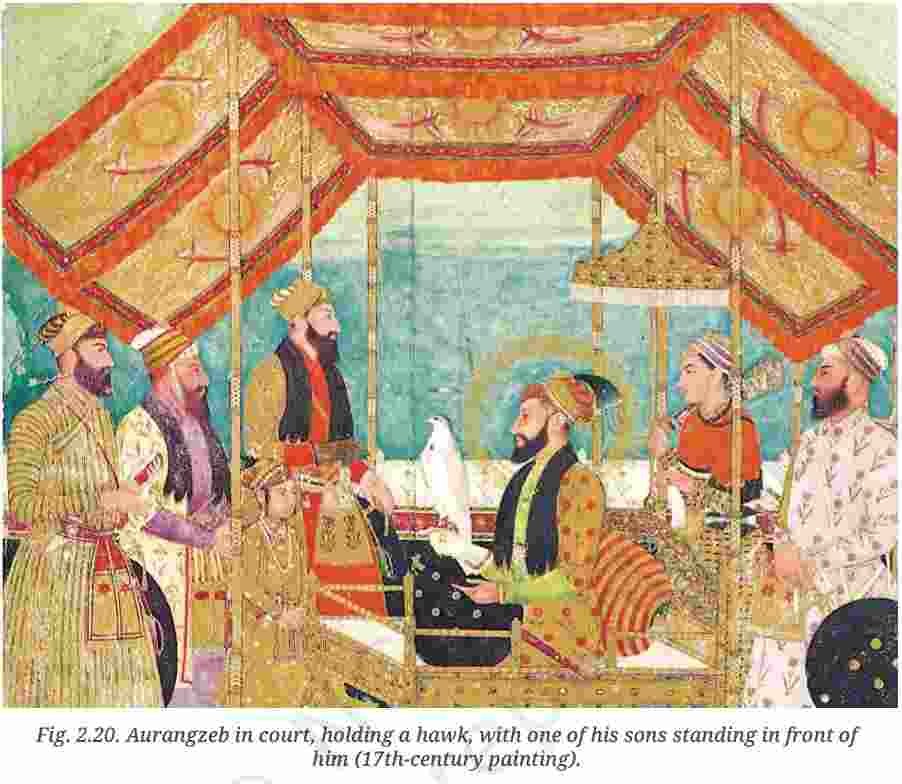
The Mughals: Exam & Revision Summary
The Mughal Empire was founded by Babur after he defeated Ibrahim Lodi in the First Battle of Panipat in 1526. Babur, a descendant of Timur, used gunpowder, field artillery and matchlock guns, which played an important role in his victory and brought the Delhi Sultanate to an end.
After Babur’s death in 1530, his son Humayun struggled to maintain the empire. Sher Shah Suri established the short-lived Sur Empire in north India, while Himu (Hemu) briefly captured Delhi. Humayun later recovered his territories, and Akbar defeated Himu in the Second Battle of Panipat, restoring Mughal control.
Babur and India
Babur recorded his experiences in the Baburnama, an important historical autobiography. It shows his interest in architecture, poetry, animals and plants, but also describes his brutality as a conqueror. Although he disliked some aspects of India, he recognised its large size, wealth, gold, silver, skilled artisans and workers, which encouraged him to remain in India and establish his empire.
Akbar
Akbar became emperor in 1556 at the age of 13 after Humayun’s death. He initially expanded the empire through military campaigns. At Chittorgarh, Rajput resistance was defeated after a long siege, followed by a large-scale massacre and enslavement. Some Rajput women performed jauhar, choosing death rather than capture and enslavement.
As Akbar’s empire expanded, he increasingly used political and administrative strategies to strengthen it. Important measures included:
- Marriage alliances with neighbouring kingdoms.
- Inclusion of Rajput and regional rulers in his court.
- Abolition of the jizya.
- Promotion of sulh-i-kul, meaning peace with all or tolerance of all faiths.
- Appointment of Hindu officials to important positions.
- Interfaith discussions and engagement with different religious traditions.
Akbar ruled from 1556 to 1605, almost 50 years. His reign included both military expansion and a relatively peaceful middle period, followed by campaigns in Kashmir, Sindh, the Deccan and Afghanistan.
Akbar was interested in Indian and Persian literature and classical Indian thought. At Fatehpur Sikri, he established a house of translation, where Sanskrit works were translated into Persian. These included the Mahabharata, Ramayana, Bhagavad Gita and Panchatantra.
Jahangir and Shah Jahan
Akbar’s son Jahangir shared his interest in art and architecture and attempted to expand Mughal influence into the Deccan.
Shah Jahan is best remembered for building the Taj Mahal at Agra. His period witnessed major developments in art, architecture, calligraphy, miniature painting and music. Important buildings included Humayun’s Tomb and the Red Forts of Delhi and Agra.
Aurangzeb
After Shah Jahan became ill in 1657, a violent succession struggle began. Aurangzeb defeated his brother Dara Shikoh, executed him, removed his other brothers and imprisoned Shah Jahan in the Agra Fort. He became emperor in 1658 and adopted the title Alamgir.
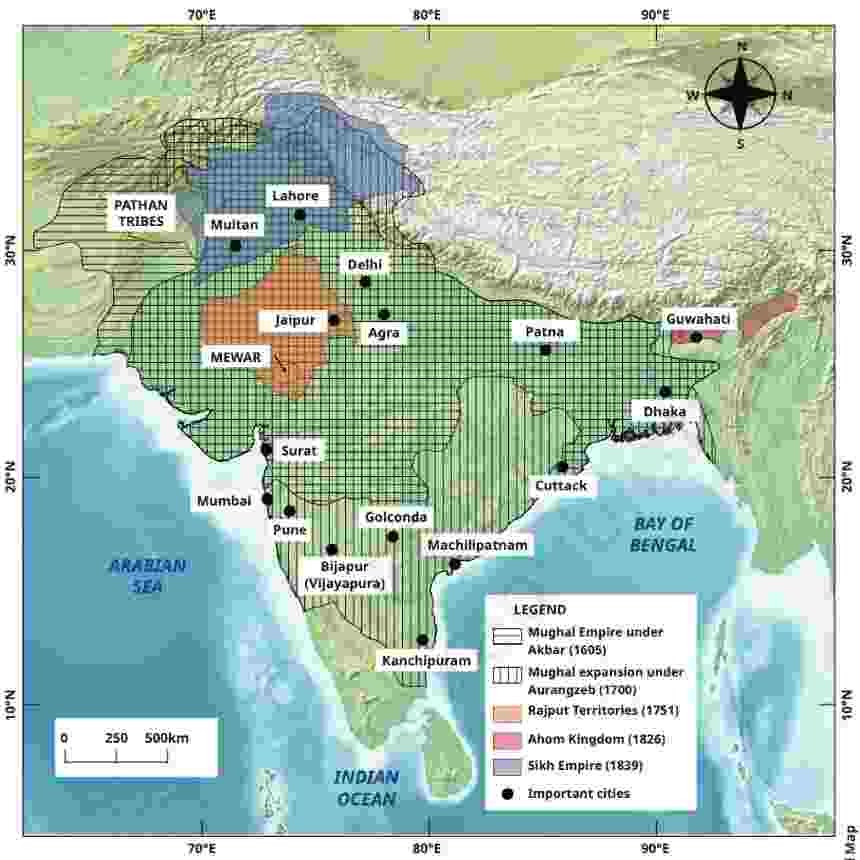
Aurangzeb expanded the Mughal Empire to its greatest territorial extent, especially in the South. However, he spent the last 25 years of his life fighting wars in the Deccan. Maintaining large armies drained the treasury and placed heavy pressure on administration. These difficulties contributed to the rapid decline of Mughal power after his death in 1707.
Aurangzeb was deeply religious and followed the Sunni tradition of Islam. Unlike Akbar, he reimposed the jizya on non-Muslims and introduced a pilgrimage tax on Hindus. He also restricted practices such as music and dance in his court.
Aurangzeb ordered the destruction of several temples, schools and religious institutions, including temples at Banaras, Mathura and Somnath, as well as some Jain temples and Sikh gurudwaras. His policies also affected Muslims belonging to other sects, including Sufis, and Zoroastrians.
Key Terms for Revision
- 1526: First Battle of Panipat; Babur defeated Ibrahim Lodi.
- Babur: Founder of the Mughal Empire.
- Baburnama: Babur’s autobiography.
- Humayun: Babur’s son who struggled to retain the empire.
- Sher Shah Suri: Founder of the Sur Empire.
- Second Battle of Panipat: Akbar defeated Himu.
- Akbar: Expanded and stabilised the Mughal Empire.
- Sulh-i-kul: Peace with all; tolerance of different faiths.
- Jizya: Tax imposed on non-Muslims under certain rulers.
- Fatehpur Sikri: Akbar’s centre for translation of important Sanskrit works.
- Jahangir: Patron of art and architecture.
- Shah Jahan: Builder of the Taj Mahal.
- Aurangzeb: Expanded the empire to its greatest extent.
- 1707: Death of Aurangzeb and subsequent rapid decline of Mughal power.
- Jauhar: Mass self-immolation by women to avoid capture and enslavement during defeat.
MCQs on NCERT Social Science Class 8 Chapter 2 Topic – The Mughals
Question 1. Who defeated Ibrahim Lodi in the First Battle of Panipat in 1526?
A. Humayun
B. Babur
C. Akbar
D. Sher Shah Suri
Answer: B. Babur
Question 2. The First Battle of Panipat marked the:
A. Beginning of the Delhi Sultanate
B. End of the Mughal Empire
C. End of the Delhi Sultanate and foundation of the Mughal Empire
D. Beginning of the Sur Empire
Answer: C. End of the Delhi Sultanate and foundation of the Mughal Empire
Question 3. Which military technologies played an important role in Babur’s victory at Panipat?
A. War elephants and swords only
B. Gunpowder, field artillery and matchlock guns
C. Cannons and rockets only
D. Naval weapons
Answer: B. Gunpowder, field artillery and matchlock guns
Question 4. Who established the Sur Empire after Humayun struggled to hold the Mughal Empire together?
A. Sher Shah Suri
B. Himu
C. Akbar
D. Ibrahim Lodi
Answer: A. Sher Shah Suri
Question 5. Who was Himu (Hemu)?
A. A Mughal emperor
B. A skilled military commander and chief minister under one of the last Suri rulers
C. A Rajput ruler
D. A governor under Akbar
Answer: B. A skilled military commander and chief minister under one of the last Suri rulers
Question 6. Under what royal name did Himu briefly rule Delhi?
A. Alamgir
B. Hemchandra Vikramaditya
C. Jalal-ud-din
D. Vikramaditya Maurya
Answer: B. Hemchandra Vikramaditya
Question 7. Who defeated Himu in the Second Battle of Panipat?
A. Babur
B. Humayun
C. Akbar
D. Sher Shah Suri
Answer: C. Akbar
Question 8. Which autobiography of Babur is an important historical source?
A. Akbarnama
B. Baburnama
C. Ain-i-Akbari
D. Tuzuk-i-Jahangiri
Answer: B. Baburnama
Question 9. Why did Babur ultimately decide to remain in India?
A. India had no political rivals
B. India was wealthy and had numerous skilled artisans and workers
C. He wanted to become a Rajput ruler
D. He was invited by Sher Shah Suri
Answer: B. India was wealthy and had numerous skilled artisans and workers
Question 10. At what age did Akbar become emperor after the death of Humayun?
A. 10 years
B. 13 years
C. 18 years
D. 25 years
Answer: B. 13 years
Question 11. What happened during Akbar’s conquest of Chittorgarh?
A. Akbar peacefully captured the fort
B. Rajput forces surrendered without resistance
C. After prolonged resistance, Akbar ordered a massacre of civilians and survivors were enslaved
D. Akbar abandoned the siege
Answer: C. After prolonged resistance, Akbar ordered a massacre of civilians and survivors were enslaved
Question 12. What was jauhar?
A. A Mughal tax on non-Muslims
B. A mass act in which Rajput women entered fires to avoid capture and enslavement
C. A system of military recruitment
D. A form of Mughal architecture
Answer: B. A mass act in which Rajput women entered fires to avoid capture and enslavement
Question 13. Which policy did Akbar promote to encourage tolerance among different faiths?
A. Jizya
B. Sulh-i-kul
C. Pilgrimage tax
D. Iconoclasm
Answer: B. Sulh-i-kul
Question 14. What does sulh-i-kul mean?
A. Rule by military force
B. Peace with all or tolerance of all faiths
C. Religious taxation
D. Conquest of all kingdoms
Answer: B. Peace with all or tolerance of all faiths
Question 15. Which of the following was an important strategy used by Akbar to stabilise his empire?
A. Excluding regional rulers from his court
B. Marriage alliances and inclusion of Rajput and regional leaders in his administration
C. Reimposing jizya
D. Ending interfaith dialogue
Answer: B. Marriage alliances and inclusion of Rajput and regional leaders in his administration
Question 16. Which tax did Akbar abolish?
A. Land revenue
B. Jizya
C. Trade tax
D. Pilgrimage tax only
Answer: B. Jizya
Question 17. What did Akbar establish at Fatehpur Sikri?
A. A military academy
B. A house of translation
C. A trading centre
D. A naval school
Answer: B. A house of translation
Question 18. Which Sanskrit text was translated into Persian during Akbar’s reign?
A. Mahābhārata
B. Arthashastra only
C. Vedas only
D. Sangam literature
Answer: A. Mahābhārata
Question 19. What was the Persian name given to the translated Mahābhārata?
A. Razmnama
B. Āmuktamālyada
C. Baburnama
D. Alamgirnama
Answer: A. Razmnama
Question 20. Which Mughal emperor is best remembered as the builder of the Taj Mahal?
A. Akbar
B. Jahangir
C. Shah Jahan
D. Aurangzeb
Answer: C. Shah Jahan
Question 21. Which statement correctly describes the Mughal period under Jahangir and Shah Jahan?
A. Art and architecture declined completely
B. Art, architecture, music, calligraphy and miniature painting flourished
C. All cultural activities were banned
D. The Mughal Empire lost all its territories
Answer: B. Art, architecture, music, calligraphy and miniature painting flourished
Question 22. Who defeated Dara Shikoh and eventually became Mughal emperor in 1658?
A. Shah Jahan
B. Aurangzeb
C. Jahangir
D. Himu
Answer: B. Aurangzeb
Question 23. What title did Aurangzeb adopt after becoming emperor?
A. Vikramaditya
B. Alamgir
C. Sultan-i-Hind
D. Shahenshah-e-Azam
Answer: B. Alamgir
Question 24. Which statement correctly describes Aurangzeb’s reign?
A. The Mughal Empire reached its greatest territorial expansion, but prolonged Deccan wars strained the empire
B. The Mughal Empire completely abandoned military campaigns
C. Aurangzeb abolished jizya and pilgrimage tax
D. The empire became stronger financially because of continuous wars
Answer: A. The Mughal Empire reached its greatest territorial expansion, but prolonged Deccan wars strained the empire
Question 25. Which of the following contributed significantly to the decline of Mughal power after Aurangzeb’s death?
A. Excessive spending on prolonged Deccan wars and the resulting strain on the treasury and administration
B. The abolition of all taxes
C. The complete end of military campaigns
D. The rise of the Vijayanagara Empire
Answer: A. Excessive spending on prolonged Deccan wars and the resulting strain on the treasury and administration
Next & Previous Topics of NCERT/CBSE Social Science Class 8 Chapter 2: Reshaping India’s Political Map
| Topics No. | Topics Name |
|---|---|
| 1 | Rise and Fall of The Delhi Sultanate |
| 2 | The Vijayanagara Empire |
| 3 | The Mughals |
| 4 | Resistance to the Mughals |
| 5 | Administering India |
| 6 | People’s Lives |
FAQs on The Mughals Class 8 Social Science
1. Who founded the Mughal Empire in India?
Answer: Babur founded the Mughal Empire in India after defeating Ibrahim Lodi at the First Battle of Panipat in 1526. His victory ended the Delhi Sultanate and laid the foundation of Mughal rule in India.
2. Why was the First Battle of Panipat important?
Answer: The First Battle of Panipat was fought in 1526 between Babur and Ibrahim Lodi. Babur used gunpowder, field artillery and matchlock guns, which had recently been introduced in warfare in India. His victory ended the Delhi Sultanate and established the Mughal Empire.
3. Who was Sher Shah Suri and what happened during his rule?
Answer: Sher Shah Suri was a powerful Afghan leader who took advantage of Humayun’s difficulties and established the Sur Empire over large parts of north India. He introduced many lasting reforms, but his empire was short-lived because Humayun soon reconquered the lost territories.
4. What policies did Akbar adopt to expand and stabilise the Mughal Empire?
Answer: Akbar used several political strategies to expand and stabilise his empire. He entered into marriage alliances with neighbouring kingdoms, welcomed Rajput and regional leaders into his court, abolished the jizya, promoted sulh-i-kul, held interfaith dialogues and appointed Hindu officials to important positions.
5. What was Akbar’s policy of sulh-i-kul?
Answer: Sulh-i-kul literally means peace with all. It was Akbar’s policy of tolerance towards all faiths. He promoted interfaith dialogue, appointed Hindu officials to high positions and abolished the jizya to gain wider support and stabilise his empire.
6. What were Akbar’s contributions to art, literature and architecture?
Answer: Akbar encouraged literature, art and architecture and invited scholars to his court. He established a house of translation at Fatehpur Sikri, where Sanskrit works such as the Mahābhārata, Rāmāyaṇa, Bhagavad Gītā and Pañchatantra were translated into Persian. The Mughal period also saw the flourishing of miniature painting, calligraphy, music and architecture.
7. Why is Shah Jahan remembered in Mughal history?
Answer: Shah Jahan is best remembered as the builder of the Taj Mahal at Agra, one of the great architectural marvels of the world. His period also witnessed remarkable architectural achievements, including the Red Forts in Delhi and Agra and the flowering of art, music, calligraphy and miniature painting.
8. How did Aurangzeb become the Mughal emperor?
Answer: When Shah Jahan fell ill in 1657, a succession struggle began among his sons. Aurangzeb defeated Dara Shikoh in a series of battles and eventually executed him. He also removed his other brothers and imprisoned Shah Jahan in the Agra Fort. Aurangzeb crowned himself emperor in 1658 and adopted the title Alamgir.
9. Why did the Mughal Empire reach its greatest territorial expansion under Aurangzeb?
Answer: Aurangzeb was skilled in military matters and conducted numerous campaigns, particularly in the Deccan. Through these campaigns, he conquered large areas of the South, and under his rule the Mughal Empire reached its greatest territorial expansion.
10. What were the main factors responsible for the decline of Mughal power after Aurangzeb?
Answer: Aurangzeb spent the last 25 years of his life fighting wars in the Deccan. Maintaining large armies for these campaigns depleted the empire’s treasury and placed great strain on the administration. The empire also faced significant rebellions. These factors contributed to the rapid decline of Mughal power after Aurangzeb’s death in 1707.