
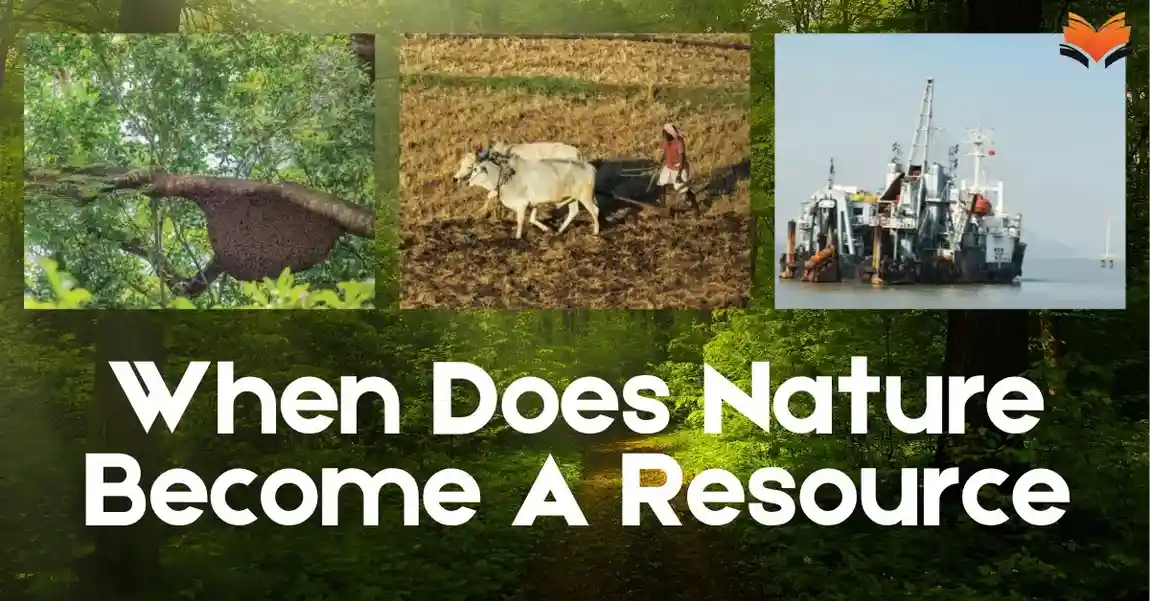
1. Meaning of Nature:
- Nature means the totality of life and non-life forms that are part of our environment.
- These forms of Nature are not created by humans.
2. When does Nature become a Resource?
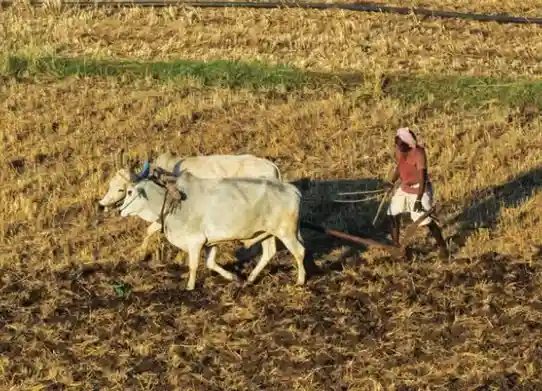
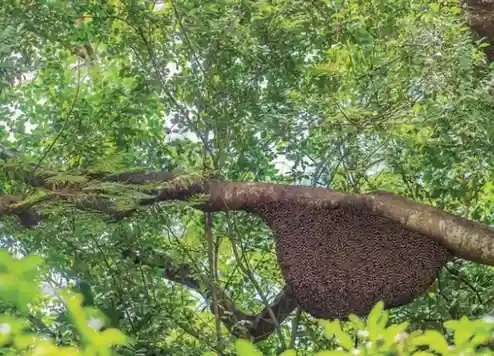
- When humans use elements of Nature for their sustenance, they become resources.
- When humans create new things for consumption from elements of Nature, they become resources.
- Example: Trees are part of the environment and exist independently of humans. When humans cut trees and convert their wood into furniture, trees are considered a resource.
3. Conditions for Something to be a Resource:
- For an entity to be called a resource:
- It should be technologically accessible.
- Its exploitation should be economically feasible.
- Its exploitation should be culturally acceptable.
4. Example of Inaccessibility:
- Petroleum may exist deep under the ocean but may not be accessible if humans do not have the technology to extract it.
- A resource may also not be used if its extraction cost is too high.
- Its use may be culturally unacceptable, such as cutting trees in sacred groves.

5. Meaning of Exploitation:
- The word exploitation usually has a negative meaning.
- In the context of natural resources, exploitation means:
- Extraction
- Utilisation
- Consumption of natural resources.
6. Treasures of the Earth:
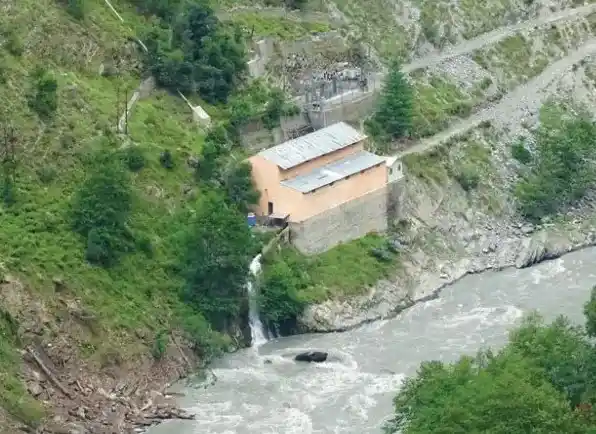
- The Earth contains many treasures that have formed over millions of years.
- Humans have taken and learnt to use these resources.
- Examples include:
- Water
- Air
- Soil
- Coal
- Petroleum
- Precious stones
- Metal ores
- Timber
7. Nature as Sacred:
- In many indigenous traditions of the world, Nature is considered sacred.
- In these traditions, Nature is viewed as a nurturer and nourisher.
8. Definition of Natural Resources:
- Natural resources are materials and substances that occur in Nature and are valuable to humans.
When Does Nature Become a Resource? – Exam & Revision Summary
Nature includes all living and non-living things that exist in our environment without being created by humans. When humans use these natural elements for sustenance, consumption, or to create useful products, they become natural resources. For example, trees are a part of Nature, but when humans use their wood to make furniture, the trees become a resource.
However, not everything found in Nature can automatically be considered a resource. For a natural element to become a resource, it must be technologically accessible, meaning humans have the technology to obtain or use it; its use must be economically feasible, meaning the cost of extraction or utilisation should be practical; and it should be culturally acceptable. For example, petroleum found deep under the ocean may not be considered an accessible resource if humans lack the technology or if extraction costs are too high. Similarly, cutting trees may not be culturally acceptable in places considered sacred, such as sacred groves.
The Earth contains many natural treasures that have formed over millions of years. These include common resources such as water, air, and soil, as well as resources like coal, petroleum, precious stones, metal ores, and timber. In many indigenous traditions, Nature is considered sacred and is seen as a nurturer and nourisher, showing that the use of natural resources is also influenced by cultural beliefs and traditions.
In simple terms, natural resources are materials and substances that occur in Nature and are valuable and useful to humans.
Quick Revision Points
- Nature: Includes all living and non-living elements not created by humans.
- Natural resource: A natural element that humans use for sustenance, consumption, or creating useful products.
- Example: Trees become a resource when their wood is used to make furniture.
- A natural element becomes a resource when it is:
- Technologically accessible
- Economically feasible
- Culturally acceptable
- Examples: Water, air, soil, coal, petroleum, timber, metal ores, and precious stones.
- Many natural resources have formed over millions of years.
- In many indigenous traditions, Nature is considered sacred and is viewed as a nurturer and nourisher.
- Key idea: Natural resources are natural materials and substances that are valuable and useful to humans.
MCQs on NCERT Social Science Class 8 Chapter 1 Topic – When Does Nature Become A Resource?
Here are the top exam-oriented MCQ-type questions on “When Does Nature Become A Resource?” that you should prepare for your CBSE or state board exams:
Question 1. Who questioned the Christian notion of man as a sinner from a scientific point of view?
A. Martin Luther
B. Copernicus
C. Galileo Galilei
D. Isaac Newton
Answer: B. Copernicus
Question 2. What did Copernicus assert about the planets?
A. They revolve around the Earth
B. They do not move
C. They, including the Earth, rotate around the Sun
D. They move randomly
Answer: C. They, including the Earth, rotate around the Sun
Question 3. Why did Copernicus not want his manuscript De revolutionibus to be printed?
A. He was unsure of his theory
B. He feared the reaction of traditionalist clergymen
C. He did not have enough money
D. He wanted to destroy his work
Answer: B. He feared the reaction of traditionalist clergymen
Question 4. To whom did Copernicus give his manuscript on his deathbed?
A. Galileo Galilei
B. Johannes Kepler
C. Joachim Rheticus
D. Martin Luther
Answer: C. Joachim Rheticus
Question 5. Who demonstrated that planets move around the Sun in ellipses rather than circles?
A. Copernicus
B. Johannes Kepler
C. Galileo Galilei
D. Isaac Newton
Answer: B. Johannes Kepler
Question 6. The scientific revolution reached its climax with whose theory of gravitation?
A. Copernicus
B. Kepler
C. Galileo
D. Isaac Newton
Answer: D. Isaac Newton
Question 7. Which of the following correctly matches the scientist with his contribution?
A. Copernicus — Sun-centred system
B. Kepler — Theory of gravitation
C. Galileo — Elliptical orbits of planets
D. Newton — De revolutionibus
Answer: A. Copernicus — Sun-centred system
Question 8. What is meant by ‘Nature’ in the given context?
A. Only living things
B. Only non-living things
C. The totality of life and non-life forms in the environment not created by humans
D. Only forests and wildlife
Answer: C. The totality of life and non-life forms in the environment not created by humans
Question 9. When do elements of Nature become resources?
A. When they exist naturally
B. When humans use them for sustenance or create new things from them for consumption
C. When they become expensive
D. When they are found underground
Answer: B. When humans use them for sustenance or create new things from them for consumption
Question 10. Which example best explains how a natural element becomes a resource?
A. A tree growing naturally in a forest
B. Wood from trees being converted into furniture
C. A mountain existing naturally
D. Rain falling on the ground
Answer: B. Wood from trees being converted into furniture
Question 11. For a natural entity to be considered a resource, it should be:
A. Technologically accessible, economically feasible and culturally acceptable
B. Expensive, rare and profitable
C. Available only in large quantities
D. Created by humans
Answer: A. Technologically accessible, economically feasible and culturally acceptable
Question 12. Why may petroleum found deep under the ocean not be considered an accessible resource?
A. It has no value
B. It may not be technologically accessible or its extraction may be too costly
C. It is not found in Nature
D. It cannot be used by humans
Answer: B. It may not be technologically accessible or its extraction may be too costly
Question 13. Why may cutting trees in sacred groves be unacceptable?
A. It is technologically impossible
B. It is economically unfeasible
C. It is culturally unacceptable
D. Trees cannot be used as resources
Answer: C. It is culturally unacceptable
Question 14. According to many indigenous traditions, Nature is considered:
A. A commodity
B. Sacred
C. A burden
D. Artificial
Answer: B. Sacred
Question 15. Which of the following best defines natural resources?
A. Materials created by humans for consumption
B. Materials and substances that occur in Nature and are valuable to humans
C. Only minerals found underground
D. Only living organisms used by humans
Answer: B. Materials and substances that occur in Nature and are valuable to humans
Next & Previous Topics of NCERT/CBSE Social Science Class 8 Chapter 1: Natural Resources and Their Use
FAQs on When Does Nature Become A Resource Class 8 Social Science
1. When does Nature become a resource?
Answer: Nature becomes a resource when humans find its elements useful and start using them to meet their needs or create useful products. For example, trees are a part of Nature, but when we cut them and use their wood to make furniture, the trees become a resource for us.
2. What is a natural resource?
Answer: A natural resource is any material or substance that comes from Nature and is useful or valuable to humans. Water, air, soil, coal, petroleum, timber, metal ores and precious stones are some common examples of natural resources.
3. What are the conditions for something in Nature to be considered a resource?
Answer: For something in Nature to be considered a resource, three things are important. It should be technologically accessible, meaning we have the technology to use it; its extraction should be economically feasible, meaning it should not be too costly; and its use should be culturally acceptable to society.
4. Why is every element of Nature not considered a resource?
Answer: Not everything found in Nature can be used as a resource. Some things may be difficult to access with the technology available to us, while others may be too expensive to extract. In some cases, using a natural element may also go against cultural beliefs or traditions. For example, petroleum deep under the ocean may be difficult or costly to extract, while cutting trees in sacred groves may not be culturally acceptable.
5. What is the difference between Nature and natural resources?
Answer: Nature includes all the living and non-living things around us that have not been created by humans. When humans find these natural elements useful and use them for their needs, they become natural resources. For example, a tree is part of Nature, but its wood used to make furniture is a resource.
6. Give an example of how a natural element becomes a resource.
Answer: A tree is a simple example. Trees naturally exist in our environment, so they are part of Nature. When humans cut a tree and use its wood to make furniture, the wood becomes a useful resource.
7. Why is technology important in making something a resource?
Answer: Technology helps us access and use natural materials that may otherwise be difficult to reach. For example, petroleum may be found deep under the ocean, but we need suitable technology to extract it. If we do not have the technology to access such a resource, we may not be able to use it.
8. What is meant by economically feasible in the context of natural resources?
Answer: Economically feasible means that extracting and using a natural resource should be affordable and practical. If it costs too much money to extract a resource compared with its usefulness or value, its exploitation may not be economically feasible.
9. What is the role of culture in determining whether something is a resource?
Answer: Culture and traditions can influence whether people consider it acceptable to use a natural resource. In some communities, certain parts of Nature are considered sacred and are protected from exploitation. For example, cutting trees in sacred groves may be culturally unacceptable, even if the wood could be useful.
10. What are some examples of natural resources?
Answer: Some common examples of natural resources are water, air, soil, coal, petroleum, precious stones, metal ores and timber. These materials occur naturally and are valuable to humans because we use them for our needs or to make useful products.