
Australia has been inhabited by Aboriginal peoples for over 40,000 years, with diverse communities, languages, and rich cultural traditions. European settlement began in the late eighteenth century, mainly with British convicts, leading to the displacement of native peoples, loss of their land, and a sharp decline in their population. Australia’s economy grew through sheep farming, mining, wheat cultivation, and vineyards. From the 1970s onwards, Australia increasingly recognised Aboriginal rights, respected native cultures, adopted multiculturalism, and acknowledged the historical injustices committed against Indigenous communities.
Topic covered: Australia class 11 notes, summary, important points and MCQs questions: Displacing Indigenous People.
We have discussed in-depth and exam-oriented pointers that can be asked in the board exam of class 11th about “Australia“ from the NCERT history notes for class 11th chapter 6 ” Displacing Indigenous People”.
Download the NCERT History for Class 11th Chapter 6 Displacing Indigenous People Notes PDF
Australia
1. Early Human Habitation in Australia:
- Human habitation in Australia has a very long history, similar to the Americas.
- Aborigines began arriving over 40,000 years ago.
- They came from New Guinea, connected to Australia by a land bridge.
- In native traditions, they believed they had always lived in Australia.
2. Dreamtime Belief:
- Past centuries were referred to as the ‘Dreamtime’.
- In Dreamtime, the distinction between past and present is blurred.
- This concept was difficult for Europeans to understand.
3. Diversity of Native Communities:
- In the late eighteenth century, there were 350–750 native communities.
- Each community had its own language.
- Even today, about 200 indigenous languages are spoken.
4. Torres Strait Islanders:
- A separate indigenous group lived in the north of Australia.
- Known as the Torres Strait Islanders.
- They are not called Aborigines.
- Believed to have migrated from elsewhere and belonged to a different race.
5. Indigenous Population Share:
- Aborigines and Torres Strait Islanders together formed 2.4 per cent of Australia’s population in 2005.
6. Geographical Settlement Pattern:
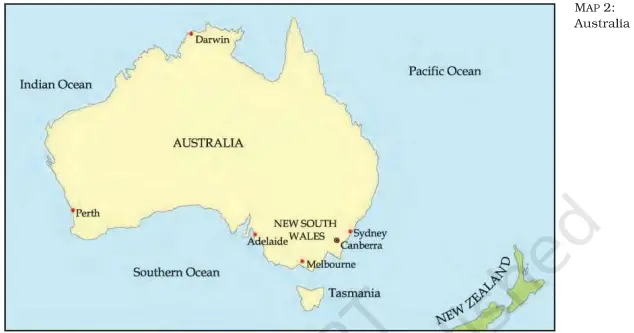
- Australia is sparsely populated.
- Most towns are located along the coast.
- British first arrived in 1770.
- The central region is an arid desert, limiting settlement.
7. Early European–Native Interaction:
- Initial encounters reported by Captain Cook described natives as friendly.
- British attitudes changed after Cook was killed by a native in Hawaii.
- A single incident was used to justify later violence by colonisers.
8. Decline of Native Population:
- Europeans did not foresee that nearly 90 per cent of natives would die.
- Causes included:
- Exposure to new germs
- Loss of land and resources
- Battles against settlers
9. Convict Settlement Policy:
- British settled Australia using convicts deported from England.
- Convicts were freed after jail terms on condition they did not return to Britain.
- Settlers forcibly ejected natives from land taken for cultivation.
10. Economic Development under Europeans:
- Economic development was less varied than in America.
- Major activities included:
- Vast sheep farms
- Mining stations
- Vineyards
- Wheat farming
- These became the basis of Australia’s prosperity.
11. Naming of the Capital:
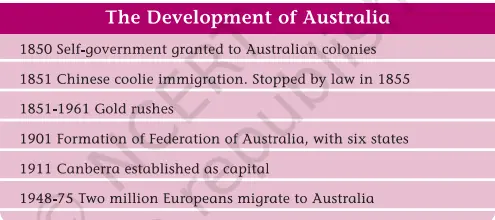
- In 1911, a new capital was planned.
- One suggested name was ‘Woolwheatgold’.
- The capital was finally named Canberra, a native word meaning ‘meeting place’.
12. Labour and Racial Policies:
- Some natives worked on farms under harsh conditions, close to slavery.
- Later, Chinese immigrants provided cheap labour.
- Fear of dependence on non-whites led to a ban on Chinese immigration.
- Until 1974, policies aimed to keep ‘non-white’ people out of Australia.
The Winds of Change
1. The Great Australian Silence:
- In 1968, W.E.H. Stanner delivered a lecture titled ‘The Great Australian Silence’.
- He highlighted historians’ silence about Aborigines.
2. Reassessment of Native Cultures:
- From the 1970s, natives were studied as living communities, not curiosities.
- Their:
- Cultures
- Knowledge of nature and climate
- Stories, art, textiles and carving were recorded and respected.
3. Challenge to Traditional History:
- Henry Reynolds’ book Why Weren’t We Told? criticised Euro-centric history.
- Condemned writing Australian history as starting with Captain Cook.
4. Institutional Changes:
- University departments were created to study native cultures.
- Native art galleries and museum exhibits were expanded.
- Natives began writing their own life histories.
5. Multiculturalism:
- From 1974, multiculturalism became official policy.
- Equal respect was given to:
- Native cultures
- Immigrant cultures from Europe and Asia
6. Land Rights and Human Rights Issues:
- Australia had no treaties with natives regarding land takeover.
- The land was declared terra nullius (belonging to nobody).
- Children of mixed descent were forcibly separated from families.
7. Government Responses:
- Two major decisions were taken:
- Recognition of natives’ historic and sacred bond with land
- Public apology for injustices to mixed-blood children
Australia – Exam & Revision Summary
Australia has been inhabited by humans for over 40,000 years, with the Aborigines being its earliest known inhabitants. They are believed to have migrated from New Guinea through a land bridge, although their own traditions state that they had always lived in Australia. Their history is linked to the concept of Dreamtime, where the distinction between the past and the present is blurred. Before European settlement, Australia had 350–750 Aboriginal communities, each with its own language and culture. Another indigenous group, the Torres Strait Islanders, lived in northern Australia and were considered culturally different from the Aborigines. Even today, most Australians live along the coast because the central region is largely an arid desert.
The arrival of the British in 1770 marked the beginning of European settlement. Initially, Captain Cook described the Aboriginal people as friendly, but attitudes changed after Cook was killed by natives in Hawaii. This incident was later used by British colonisers to justify violence against Aboriginal communities in Australia. During the nineteenth and twentieth centuries, nearly 90% of the Aboriginal population died because of diseases introduced by Europeans, the loss of their lands and resources, and violent conflicts with settlers.
Unlike North America, most early British settlers in Australia were convicts transported from England. After completing their prison sentences, they were allowed to settle permanently in Australia if they did not return to Britain. To establish farms and settlements, they forcibly occupied Aboriginal lands, displacing native communities from their traditional homes.
Australia’s economy under European rule developed mainly through sheep farming, mining, vineyards, and wheat cultivation, which became the foundation of the country’s prosperity. Some Aboriginal people worked on farms under harsh conditions similar to slavery. Later, Chinese immigrants were brought as cheap labour, but fear of non-white immigration led Australia to introduce policies restricting Chinese and other Asian immigrants. Until 1974, Australia followed policies that discouraged non-white immigration, commonly known as the White Australia Policy.
For many years, Australian history largely ignored the contribution and suffering of Aboriginal people. This changed after anthropologist W. E. H. Stanner’s influential 1968 lecture, “The Great Australian Silence,” which criticised historians for excluding Aboriginal history. From the 1970s onwards, scholars, museums, and universities began documenting Aboriginal culture, traditions, languages, art, and history. Aboriginal writers also started publishing their own life stories, helping preserve their cultural heritage.
In 1974, Australia officially adopted multiculturalism, recognising and respecting both Aboriginal cultures and the cultures of immigrants from Europe and Asia. Growing awareness of human rights also highlighted the injustice faced by Aboriginal people. Unlike countries such as the USA, Canada, and New Zealand, Australia had never signed treaties with its indigenous people. Instead, the government had claimed Australia was terra nullius, meaning “land belonging to nobody,” to justify European occupation.
Public campaigns during the late twentieth century led to important reforms. The Australian government acknowledged that Aboriginal people had a deep spiritual and historical connection with their ancestral lands and recognised that these sacred relationships should be respected. It also apologised for the Stolen Generations, in which children of mixed Aboriginal and European ancestry had been forcibly separated from their families in an attempt to promote racial separation.
Today, Australia increasingly recognises the importance of Aboriginal history, culture, languages, art, and land rights, although the process of achieving justice and equality continues.
Quick Revision Points
- Aboriginal people have lived in Australia for over 40,000 years.
- The concept of Dreamtime is central to Aboriginal traditions.
- Torres Strait Islanders are a separate indigenous group.
- Captain Cook reached Australia in 1770.
- Around 90% of Aboriginal people died due to disease, land loss, and conflict after European settlement.
- Most early British settlers were convicts transported from England.
- Australia’s economy developed mainly through sheep farming, mining, wheat cultivation, and vineyards.
- The White Australia Policy restricted non-white immigration until 1974.
- W. E. H. Stanner’s lecture “The Great Australian Silence” (1968) highlighted the neglect of Aboriginal history.
- Multiculturalism became official government policy in 1974.
- The doctrine of terra nullius claimed Australia belonged to nobody before European settlement.
- The government later recognised Aboriginal land rights and apologised for the Stolen Generations.
- Today, Aboriginal culture and history are officially recognised and preserved.
MCQs on NCERT History Class 11 Chapter 6 Topic – Australia
Here are the top exam-oriented MCQ-type questions on “Australia Class 11” that you should prepare for your CBSE or state board exams:
Question 1. The aborigines began arriving in Australia about
A. 10,000 years ago
B. 20,000 years ago
C. Over 40,000 years ago
D. After the Ice Age
Answer: C
Question 2. The aborigines are believed to have reached Australia from
A. Indonesia
B. Polynesia
C. New Guinea
D. Africa
Answer: C
Question 3. New Guinea was connected to Australia by
A. Sea routes
B. Mountains
C. A land-bridge
D. Ice sheets
Answer: C
Question 4. According to native traditions, aborigines believed that
A. They migrated from Asia
B. They came during the Ice Age
C. They had always been in Australia
D. They were brought by Europeans
Answer: C
Question 5. The term used by aborigines for the past centuries was
A. Stone Age
B. Dreamtime
C. Dark Age
D. Ancient Time
Answer: B
Question 6. The concept of ‘Dreamtime’ was difficult for Europeans to understand because
A. It rejected religion
B. It denied history
C. It blurred the distinction between past and present
D. It was written in symbols
Answer: C
Question 7. In the late eighteenth century, the number of native communities in Australia ranged between
A. 100–200
B. 200–300
C. 350–750
D. 800–1000
Answer: C
Question 8. Each native community in Australia had
A. A common religion
B. A common culture
C. Its own language
D. The same customs
Answer: C
Question 9. Even today, about how many indigenous languages are spoken in Australia?
A. 50
B. 100
C. 150
D. 200
Answer: D
Question 10. The indigenous people living in northern Australia are known as
A. Aborigines
B. Maoris
C. Torres Strait Islanders
D. Bushmen
Answer: C
Question 11. The term ‘Aborigine’ is not used for Torres Strait Islanders because they
A. Live in cities
B. Migrated from elsewhere and belong to a different race
C. Speak English
D. Arrived later with Europeans
Answer: B
Question 12. Together, aborigines and Torres Strait Islanders made up what percentage of Australia’s population in 2005?
A. 1.2%
B. 1.8%
C. 2.4%
D. 3.5%
Answer: C
Question 13. Most Australian towns developed along the coast because
A. The soil was fertile there
B. The central region was forested
C. The British first arrived on the coast and the interior was arid
D. Natives lived only on the coast
Answer: C
Question 14. The British first arrived in Australia in
A. 1750
B. 1760
C. 1770
D. 1788
Answer: C
Question 15. Initial reports by Captain Cook about natives described them as
A. Hostile
B. Violent
C. Friendly
D. Uncivilised
Answer: C
Question 16. British attitudes changed sharply after Captain Cook was
A. Attacked in Australia
B. Killed in Hawaii
C. Imprisoned
D. Betrayed by settlers
Answer: B
Question 17. The killing of Cook was used by colonisers to
A. End exploration
B. Negotiate peace
C. Justify violence against natives
D. Withdraw from colonies
Answer: C
Question 18. Nearly what percentage of the native population died in the nineteenth and twentieth centuries?
A. 50%
B. 65%
C. 75%
D. 90%
Answer: D
Question 19. The main reasons for the decline of native population were
A. Famines only
B. Forced conversions
C. Germs, loss of land, and wars
D. Migration
Answer: C
Question 20. The Portuguese experiment of settling Brazil with convicts was abandoned because
A. Convicts escaped
B. Convicts rebelled
C. Convict violence provoked native reprisals
D. It was too expensive
Answer: C
Question 21. The British first used convicts as settlers in
A. Australia
B. South Africa
C. American colonies
D. Ireland
Answer: C
Question 22. After American independence, British convicts were sent mainly to
A. Canada
B. Africa
C. Australia
D. New Zealand
Answer: C
Question 23. Convicts in Australia were allowed to live as free people after their sentence on the condition that they
A. Paid taxes
B. Joined the army
C. Did not return to Britain
D. Converted natives
Answer: C
Question 24. European settlers showed little hesitation in ejecting natives because
A. Natives had no religion
B. Land was officially empty
C. They had no option but to survive
D. Natives sold the land
Answer: C
Question 25. Australia’s economic development under European settlement was
A. Highly industrial
B. Based on trade only
C. Less varied than America
D. Dependent on factories
Answer: C
Question 26. The main economic activities in Australia included
A. Cotton and rice farming
B. Sheep farming and mining
C. Tea and coffee plantations
D. Manufacturing industries
Answer: B
Question 27. Vineyards and wheat farming developed
A. Before sheep farms
B. Alongside industries
C. After sheep farming and mining
D. Only in coastal areas
Answer: C
Question 28. These economic activities formed the basis of Australia’s
A. Democracy
B. Trade relations
C. Prosperity
D. Military power
Answer: C
Question 29. The year in which it was decided to build a new capital for Australia was
A. 1890
B. 1901
C. 1911
D. 1920
Answer: C
Question 30. The suggested name ‘Woolwheatgold’ reflected
A. Native culture
B. Religious beliefs
C. Economic activities
D. British traditions
Answer: C
Question 31. Canberra is derived from a native word meaning
A. Capital city
B. Sacred land
C. Meeting place
D. New beginning
Answer: C
Question 32. Conditions of work for natives employed on farms were
A. Fair
B. Temporary
C. Similar to slavery
D. Well regulated
Answer: C
Question 33. Later, cheap labour in Australia was provided by
A. Africans
B. Indians
C. Chinese immigrants
D. Europeans
Answer: C
Question 34. Fear of dependence on non-whites led to
A. Encouraging migration
B. Banning Chinese immigrants
C. Granting citizenship
D. Land reforms
Answer: B
Question 35. Till 1974, Australia followed a policy to
A. Encourage Asian migration
B. Promote multiculturalism
C. Keep non-white people out
D. Integrate natives
Answer: C
Question 36. The lecture ‘The Great Australian Silence’ was delivered by
A. Henry Reynolds
B. W.E.H. Stanner
C. Peter Burke
D. Oodgeroo Noonuccal
Answer: B
Question 37. ‘The Great Australian Silence’ referred to
A. Lack of native voices
B. Silence of historians about aborigines
C. Decline of languages
D. Loss of rituals
Answer: B
Question 38. From the 1970s, natives began to be understood as
A. Backward tribes
B. Anthropological curiosities
C. Communities with distinct cultures
D. Political threats
Answer: C
Question 39. The book Why Weren’t We Told? was written by
A. W.E.H. Stanner
B. Peter Burke
C. Henry Reynolds
D. Captain Cook
Answer: C
Question 40. The book criticised Australian history for beginning with
A. British settlement
B. Federation
C. Captain Cook’s ‘discovery’
D. Industrialisation
Answer: C
Question 41. From the 1970s onwards, which of the following developments took place?
A. Native cultures were ignored
B. Native art galleries and university departments were established
C. Natives were removed from museums
D. Indigenous history was banned
Answer: B
Question 42. From 1974, Australia officially adopted the policy of
A. White Australia
B. Assimilation
C. Multiculturalism
D. Segregation
Answer: C
Question 43. Australia had no treaties with natives because the land was termed
A. Sacred land
B. Crown land
C. Terra nullius
D. Tribal land
Answer: C
Question 44. ‘Terra nullius’ means
A. Land under protection
B. Land belonging to nobody
C. Empty desert
D. Common land
Answer: B
Question 45. One major injustice faced by natives was
A. Forced labour
B. Forced religious conversion
C. Separation of mixed-blood children
D. Denial of education
Answer: C
Question 46. Public agitation led to recognition that
A. Natives had no history
B. Native land bonds were sacred and historic
C. Past injustices could be reversed
D. Colonisation was justified
Answer: B
Question 47. One of the decisions taken was to
A. Return all land
B. Deny responsibility
C. Offer a public apology
D. Remove immigrants
Answer: C
Next & Previous Topics of NCERT/CBSE History Class 11 Chapter 6: Displacing Indigenous People
| Topics No. | Topics Name |
|---|---|
| 1 | European Imperialism |
| 2 | North America |
| 3 | Australia |
FAQs on Australia
1. Who were the first inhabitants of Australia?
Answer: The first inhabitants of Australia were the Aboriginal peoples, who arrived from New Guinea over 40,000 years ago through a land bridge. According to their traditions, they had always belonged to Australia. Before European settlement, there were between 350 and 750 Aboriginal communities, each with its own language, culture, and traditions.
2. What is the Dreamtime in Aboriginal culture?
Answer: Dreamtime is a central belief in Aboriginal culture that explains the origins of the world, people, and nature. Unlike the European view of history, Dreamtime does not clearly separate the past from the present. It reflects the deep spiritual connection of Aboriginal people with their ancestors, land, and traditions.
3. How did British settlement affect the Aboriginal people of Australia?
Answer: British settlement had devastating effects on Aboriginal communities. Many died from diseases introduced by Europeans, while others lost their land and resources or were killed in conflicts with settlers. During the nineteenth and twentieth centuries, nearly 90% of the Aboriginal population was affected by these changes.
4. Why did Britain send convicts to Australia?
Answer: After losing its American colonies, Britain began sending convicts to Australia as a penal settlement. Once their prison terms ended, many convicts were allowed to live as free settlers, provided they did not return to Britain. They occupied land that traditionally belonged to Aboriginal communities.
5. What was the basis of Australia’s economic development under European settlement?
Answer: Australia’s economy developed mainly through sheep farming, mining, wheat cultivation, and vineyards. These industries became the foundation of the country’s prosperity. Unlike North America, Australia’s economic growth relied heavily on pastoral farming and mineral resources rather than large-scale industrial development.
6. What changes took place in Australia from the 1970s regarding Aboriginal people?
Answer: From the 1970s, Australia began recognising Aboriginal cultures and history. Universities introduced Indigenous studies, museums expanded exhibits on Aboriginal heritage, and multiculturalism became official policy in 1974. Greater respect was also given to Aboriginal traditions, languages, art, and their cultural contributions.
7. What is terra nullius, and why is it significant in Australian history?
Answer: Terra nullius means “land belonging to nobody.” For many years, the Australian government used this idea to justify European occupation without signing treaties with Aboriginal peoples. Later, Australia recognised that Aboriginal communities had deep historical and spiritual connections with the land, leading to reforms and public acknowledgment of past injustices.