
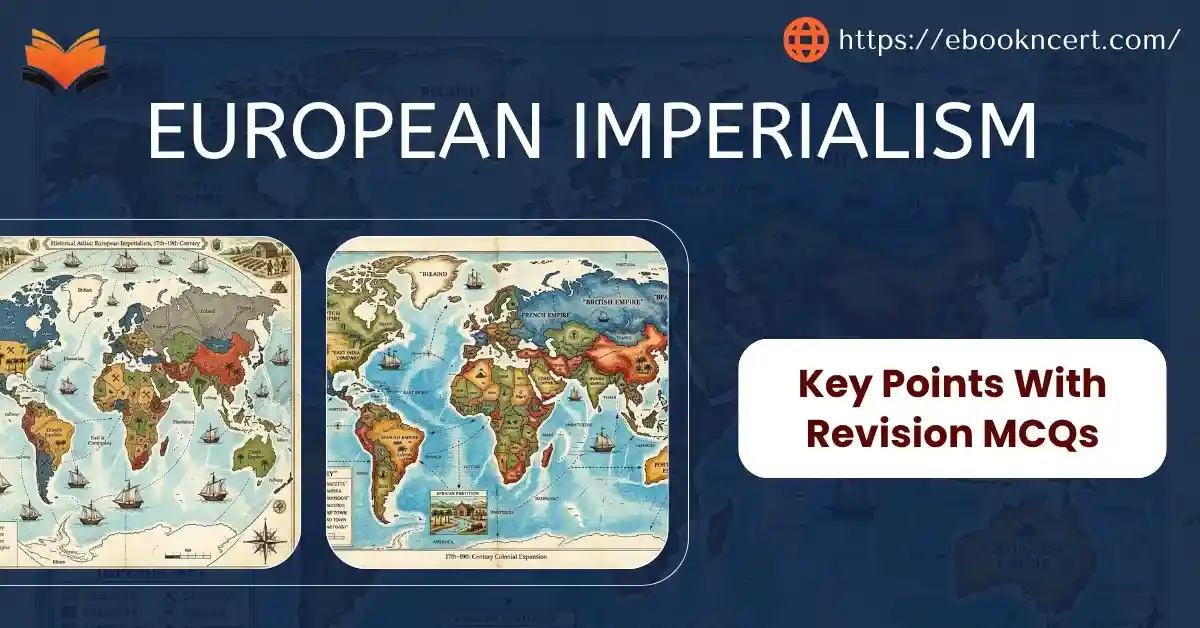
European Imperialism was the policy through which European countries expanded their control over Asia, Africa, and America to gain trade, wealth, and political power. Countries like Britain, France, and Holland established colonies and controlled local rulers. In Asia and Africa, they exploited natural resources, collected taxes, and developed transport systems mainly for economic benefits. This expansion led to the spread of European influence across many parts of the world.
Topic covered: European Imperialism class 11 notes, summary, important points and MCQs questions: Displacing Indigenous People.
We have discussed in-depth and exam-oriented pointers that can be asked in the board exam of class 11th about “European Imperialism“ from the NCERT history notes for class 11th chapter 6 ” Displacing Indigenous People”.
Download the NCERT History for Class 11th Chapter 6 Displacing Indigenous People Notes PDF
European Imperialism
1. Decline of Spanish and Portuguese Expansion:
- The American empires of Spain and Portugal did not expand after the seventeenth century.
2. Rise of New Colonial Powers:
- From the seventeenth century, France, Holland and England began expanding trade.
- These countries started establishing colonies in America, Africa and Asia.
3. Ireland as an English Colony:
- Ireland was virtually a colony of England.
- Most landowners in Ireland were English settlers.
4. Profit as the Main Motive of Colonialism:
- From the eighteenth century, profit became the main driving force behind colonial expansion.
- People established colonies mainly for economic gain.
5. Variations in Colonial Control:
- There were significant differences in how colonies were controlled.
- The nature of colonial rule was not the same everywhere.
6. Colonial Expansion in South Asia:
- Trading companies like the East India Company became political powers.
- They defeated local rulers and annexed territories.
7. Use of Existing Administrative Systems:
- The British retained older, well-developed administrative systems.
- Taxes were collected from landowners.
8. Economic Infrastructure Development:
- Railways were built to facilitate trade.
- Mines were excavated.
- Large plantations were established.
9. European Presence in Africa:
- Europeans mainly traded along the African coast.
- South Africa was an exception to this pattern.
10. Late Penetration into the African Interior:
- Europeans entered the interior of Africa only in the late nineteenth century.
11. Partition of Africa:
- European countries agreed among themselves to divide Africa into colonies.
12. Meaning of the Term ‘Settler’:
- The term ‘settler’ refers to:
- Dutch in South Africa
- British in Ireland, New Zealand and Australia
- Europeans in America
13. Official Languages in Settler Colonies:
- English was the official language in these colonies.
- Canada was an exception, where French was also an official language.
Names given by Europeans to Countries of the ‘New World’
- ‘AMERICA’ – First used after the publication of the travels of Amerigo Vespucci (1451–1512)
- ‘CANADA’ – from kanata (= ‘village’ in the language of the Huron-Iroquois, as heard by the explorer Jacques Cartier in 1535)
- ‘AUSTRALIA’ – Sixteenth-century name for land in the Great Southern Ocean (austral is Latin for ‘south’)
- ‘NEW ZEALAND’ – Name given by Tasman of Holland, who was the first to sight these islands in 1642 (see Dutch for ‘sea’)
Note: The Geographical Dictionary (pp. 805–82) lists over a hundred place-names in the Americas and Australia which begin with ‘New’.
European Imperialism – Exam & Revision Summary
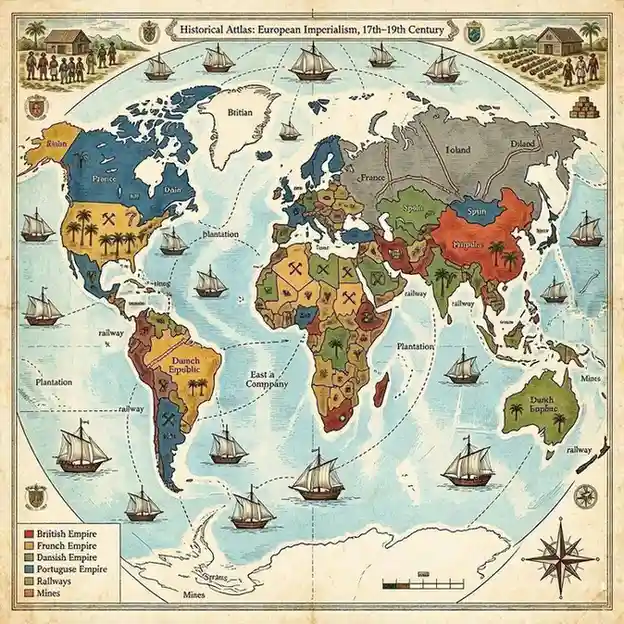
After the seventeenth century, the American empires of Spain and Portugal stopped expanding. From this period, countries such as France, Holland, and England began extending their trade and establishing colonies in America, Africa, and Asia. Ireland also became almost a colony of England because most of its landowners were English settlers.
The main objective behind European imperialism was economic profit. European nations established colonies to increase trade and gain wealth, although the methods of control differed from region to region.
In South Asia, trading companies such as the East India Company gradually became political powers. They defeated local rulers, annexed territories, and collected taxes from landowners. The British continued the existing administrative system and later developed railways, mines, and plantations mainly to promote trade and exploit resources.
In Africa, Europeans initially remained limited to coastal trade, except in South Africa. During the late nineteenth century, they moved into the interior regions of Africa. European powers later reached agreements among themselves to divide Africa into colonies.
The term “settler” was used for Europeans who permanently settled in colonies. Examples include the Dutch in South Africa, the British in Ireland, Australia, and New Zealand, and Europeans in America. English became the official language in most settler colonies, while Canada recognized both English and French as official languages.
Quick Revision Points
- Spain and Portugal stopped expanding after the seventeenth century.
- France, Holland, and England expanded their colonies in America, Africa, and Asia.
- Economic profit was the main reason behind imperialism.
- The East India Company became a political power in South Asia.
- Railways, mines, and plantations were developed mainly for trade and resource extraction.
- Africa was divided among European powers during the late nineteenth century.
- Settlers were Europeans who permanently settled in colonies.
- English became the official language in most settler colonies, while Canada had both English and French.
MCQs on NCERT History Class 11 Chapter 6 Topic – European Imperialism
Here are the top exam-oriented MCQ-type questions on “European Imperialism Class 11” that you should prepare for your CBSE or state board exams:
Question 1. The American empires of Spain and Portugal stopped expanding after the
A. Sixteenth century
B. Seventeenth century
C. Eighteenth century
D. Nineteenth century
Answer: B. Seventeenth century
Question 2. After the seventeenth century, colonial expansion was led mainly by
A. Spain and Portugal
B. Italy and Germany
C. France, Holland and England
D. Russia and Turkey
Answer: C. France, Holland and England
Question 3. France, Holland and England expanded mainly by
A. Religious missions
B. Military alliances
C. Trading activities and colonies
D. Cultural exchanges
Answer: C. Trading activities and colonies
Question 4. These new colonies were established in
A. Europe only
B. America, Africa and Asia
C. Asia and Europe
D. Africa and Europe
Answer: B. America, Africa and Asia
Question 5. Ireland was virtually a colony of England because
A. It was ruled by the British army
B. English was spoken there
C. Most landowners were English settlers
D. It was economically backward
Answer: C. Most landowners were English settlers
Question 6. From the eighteenth century, the main motive behind establishing colonies was
A. Spread of Christianity
B. Political rivalry
C. Prospect of profit
D. Scientific exploration
Answer: C. Prospect of profit
Question 7. The nature of colonial control after the eighteenth century was
A. Uniform everywhere
B. Entirely military
C. Highly decentralised
D. Varied from region to region
Answer: D. Varied from region to region
Question 8. In South Asia, colonial control was mainly established by
A. European kings
B. Missionaries
C. Trading companies
D. Settler farmers
Answer: C. Trading companies
Question 9. Which trading company became a political power in South Asia?
A. Dutch East India Company
B. East India Company
C. Royal African Company
D. Hudson’s Bay Company
Answer: B. East India Company
Question 10. Trading companies in South Asia became political powers by
A. Negotiation only
B. Religious influence
C. Defeating local rulers
D. Cultural assimilation
Answer: C. Defeating local rulers
Question 11. After defeating local rulers, the companies
A. Returned territories
B. Annexed territories
C. Abolished administration
D. Left governance to locals
Answer: B. Annexed territories
Question 12. In South Asia, colonial rulers retained
A. Only military control
B. European administrative systems
C. Older well-developed administrative systems
D. No administrative structure
Answer: C. Older well-developed administrative systems
Question 13. Taxes in South Asia were mainly collected from
A. Peasants directly
B. Merchants
C. Kings
D. Landowners
Answer: D. Landowners
Question 14. Railways in South Asia were built mainly to
A. Improve travel for locals
B. Promote tourism
C. Strengthen defence
D. Make trade easier
Answer: D. Make trade easier
Question 15. Which of the following activities were introduced later by colonial powers in South Asia?
A. Mining and plantations
B. Religious schools
C. Local crafts
D. Village councils
Answer: A. Mining and plantations
Question 16. In Africa, Europeans mainly traded
A. In the interior
B. In deserts
C. On the coast
D. In forests
Answer: C. On the coast
Question 17. An exception to coastal trading in Africa was
A. Egypt
B. Nigeria
C. South Africa
D. Kenya
Answer: C. South Africa
Question 18. Europeans entered the African interior mainly in the
A. Seventeenth century
B. Eighteenth century
C. Early nineteenth century
D. Late nineteenth century
Answer: D. Late nineteenth century
Question 19. After entering the African interior, European countries
A. Fought continuous wars
B. Agreed to divide Africa
C. Withdrew from Africa
D. Handed control to locals
Answer: B. Agreed to divide Africa
Question 20. The division of Africa was done
A. Through religious councils
B. By African rulers
C. By European agreements
D. Through public voting
Answer: C. By European agreements
Question 21. The term ‘settler’ refers to
A. Local inhabitants
B. Temporary traders
C. Europeans who settled permanently
D. Soldiers only
Answer: C. Europeans who settled permanently
Question 22. Dutch settlers are associated mainly with
A. Australia
B. Ireland
C. South Africa
D. Canada
Answer: C. South Africa
Question 23. British settlers are associated with all EXCEPT
A. Ireland
B. New Zealand
C. Australia
D. Brazil
Answer: D. Brazil
Question 24. European settlers in America were mainly
A. Africans
B. Asians
C. Europeans
D. Indigenous people
Answer: C. Europeans
Question 25. The official language in most settler colonies was
A. French
B. Spanish
C. Portuguese
D. English
Answer: D. English
Question 26. Which colony had French as an additional official language?
A. Australia
B. New Zealand
C. Canada
D. Ireland
Answer: C. Canada
Question 27. English was NOT the official language in
A. Ireland
B. Australia
C. Canada
D. New Zealand
Answer: C. Canada
Question 28. Canada differed from other settler colonies because
A. It had no settlers
B. It was not a colony
C. French was also an official language
D. It was ruled by Spain
Answer: C. French was also an official language
Next & Previous Topics of NCERT/CBSE History Class 11 Chapter 6: Displacing Indigenous People
| Topics No. | Topics Name |
|---|---|
| 1 | European Imperialism |
| 2 | North America |
| 3 | Australia |
FAQs on European Imperialism (Exam Focused)
1. What is European Imperialism?
Answer: European Imperialism was the policy in which European countries expanded their control over Asia, Africa, and America. They aimed to increase trade, gain wealth, and strengthen political power. Countries like Britain, France, and Holland established colonies and influenced local economies and governance systems.
2. Why did European countries expand their colonies?
Answer: European countries expanded colonies mainly for economic profit. They wanted raw materials, new markets, and greater trade opportunities. Colonies also helped them increase political influence and compete with other European powers.
3. Which European countries became major colonial powers after the seventeenth century?
Answer: After the seventeenth century, Britain, France, and Holland became major colonial powers. They expanded trade networks and established colonies in America, Africa, and Asia as the earlier empires of Spain and Portugal declined.
4. How did the East India Company become a political power in South Asia?
Answer: The East India Company started as a trading organization but gradually defeated local rulers, annexed territories, and gained political control. It became a major governing authority in South Asia and collected taxes from landowners.
5. How did British colonial rule affect South Asia?
Answer: The British retained existing administrative systems and collected taxes through local landowners. They also developed railways, mines, and plantations mainly to support trade and extract resources for economic benefit.
6. What was the Partition of Africa?
Answer: The Partition of Africa was the process in which European countries divided African territories among themselves during the late nineteenth century. This division allowed them to establish colonies and control resources across the continent.
7. What is meant by a settler colony?
Answer: A settler colony was a colony where Europeans permanently settled. Examples include Australia, New Zealand, South Africa, and America. English became the dominant official language in most of these colonies, except Canada, where both English and French were used.