
North America extends from the Arctic Circle to the Tropic of Cancer and is rich in forests, fertile plains, rivers, minerals, oil, and natural gas. The continent was originally inhabited by native peoples who lived through hunting, fishing, farming, and close harmony with nature. From the seventeenth century, European traders and settlers arrived, leading to colonisation, expansion of agriculture, and industrial growth. This resulted in the displacement of native communities and the loss of much of their land. During the nineteenth century, the USA and Canada became powerful nations through rapid economic and industrial development, while native peoples continued to fight for their land, rights, and cultural identity.
Topic covered: North America class 11 notes, summary, important points and MCQs questions: Displacing Indigenous People.
We have discussed in-depth and exam-oriented pointers that can be asked in the board exam of class 11th about “North America“ from the NCERT history notes for class 11th chapter 6 ” Displacing Indigenous People”.
Download the NCERT History for Class 11th Chapter 6 Displacing Indigenous People Notes PDF
North America
1. Geographical Features of North America:
- North America extends from the Arctic Circle to the Tropic of Cancer.
- It stretches from the Pacific Ocean to the Atlantic Ocean.
- Major physical features include:
- Rocky Mountains
- Deserts of Arizona and Nevada
- Sierra Nevada mountains
- Great Plains
- Great Lakes
- Valleys of the Mississippi and Ohio rivers
- Appalachian Mountains
- Mexico lies to the south of the continent.
2. Natural Resources and Economic Activities:
- About 40 per cent of Canada is covered with forests.
- Oil, gas and mineral resources are found in many areas.
- Availability of resources explains the growth of big industries in the USA and Canada.
- Wheat, corn and fruits are grown extensively.
- Fishing is a major industry in Canada.
- Mining, industry and extensive agriculture developed mainly in the last 200 years.
3. Early Population of North America:
- People lived in North America thousands of years before Europeans arrived.
- Development of mining and agriculture was carried out later by immigrants from Europe, Africa and China.
The Native Peoples
1. Origins of Native Peoples:
- Earliest inhabitants came from Asia over 30,000 years ago.
- They crossed a land bridge across the Bering Straits.
- During the last Ice Age (10,000 years ago), they moved southwards.
- The oldest artefact found is an 11,000-year-old arrow-point.
2. Population Growth and Settlement:
- Population increased about 5,000 years ago due to stable climate.
- Lived in bands and villages along river valleys.
3. Food and Economic Life:
- Diet included fish, meat, vegetables and maize.
- Hunted bison, the wild buffalo of the grasslands.
- From the seventeenth century, hunting became easier after acquiring horses from Spanish settlers.
- Killed only as many animals as needed for food.
4. Land and Agriculture:
- Did not practise extensive agriculture.
- Did not produce surplus.
- As a result, they did not develop kingdoms or empires.
- Control of land was generally not an issue.
- They did not feel the need to ‘own’ land.
5. Social and Cultural Practices:
- Followed traditions of formal alliances and gift exchange.
- Goods were obtained as gifts, not through buying.
- Spoke numerous languages, which were not written down.
- Believed time moved in cycles.
- Tribal histories were passed orally from generation to generation.
- Skilled craftspeople who wove beautiful textiles.
- Could read landscapes and climates like written texts.
Encounters with Europeans
1. Early European Contact:
- In the seventeenth century, European traders reached North America after a difficult voyage.
- Native peoples were friendly and welcoming.
- Europeans traded mainly in fish and furs, not gold.
2. Trade Relations:
- Natives helped Europeans by hunting.
- French observed regular native gatherings for exchange of handicrafts and food.
- Europeans gave:
- Blankets
- Iron vessels
- Guns
- Alcohol
3. Impact of Trade:
- Alcohol addiction developed among natives.
- This allowed Europeans to dictate trade terms.
- Europeans adopted tobacco from natives.
Mutual Perceptions
1. European Views of Natives:
- Europeans defined civilisation through literacy, organised religion and cities.
- Natives were viewed as ‘uncivilised’.
- Rousseau admired them as ‘noble savages’.
- Wordsworth viewed them as having limited imagination and emotion.
2. Native Views of Europeans
- Natives saw exchanged goods as symbols of friendship.
- Europeans treated fish and furs as commodities for profit.
- Natives could not understand market-based price fluctuations.
- They were disturbed by European greed and over-hunting of animals.
3. Settlement and Land Conflict:
- Europeans later came as settlers.
- Many settlers were religiously persecuted groups.
- Forests were cleared using iron tools to create farms.
- Europeans imagined forests as future cornfields.
- Jefferson believed in a nation of European small farmers.
- Natives grew crops for use, not for sale, and rejected land ownership.
4. Expansion of USA and Canada:
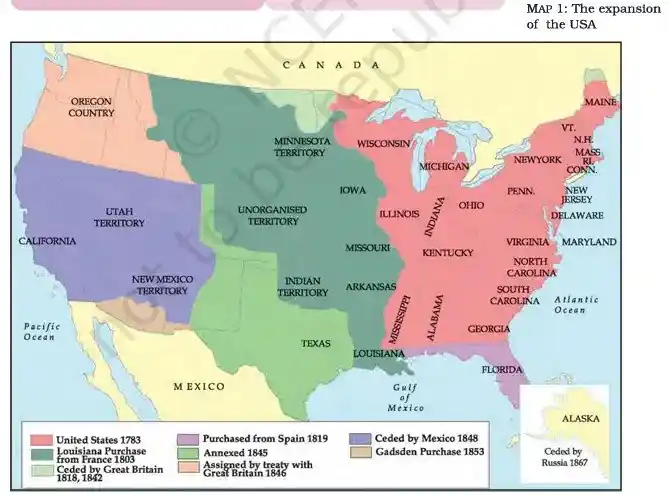
- USA and Canada emerged at the end of the eighteenth century.
- Initially occupied only a fraction of present land.
- Expansion occurred through:
- Purchase (Louisiana, Alaska)
- War (land from Mexico)
- Native consent was never sought.
- Natives were forced westward as the frontier shifted.
5. Slavery and Civil War:
- Southern climate unsuitable for European labour.
- African slaves were brought for plantations.
- Slave trade was banned, but slavery continued.
- Northern states opposed slavery.
- Civil War (1861–65) ended slavery.
- Civil rights for African Americans achieved only in the twentieth century.
The Native Peoples Lose Their Land
1. Forced Removal and Treaties:
- Natives were forced to sign treaties selling land at low prices.
- Many were cheated.
2. Cherokee Case:
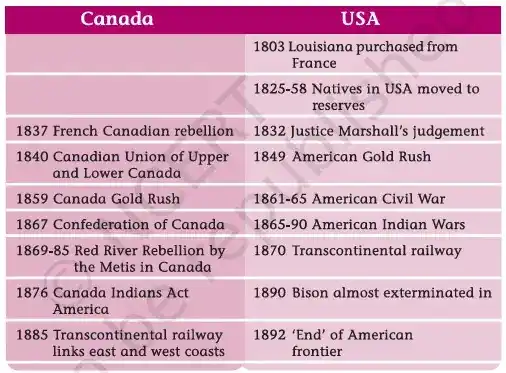
- Chief Justice John Marshall recognised Cherokee sovereignty (1832).
- President Andrew Jackson ignored the judgment.
- Cherokees were forcibly removed.
- Over a quarter died on the Trail of Tears.
3. Reservations and Resistance:
- Natives were confined to reservations.
- Lands were repeatedly taken if minerals were found.
- US army crushed rebellions (1865–1890).
- Metis revolts occurred in Canada (1869–1885).
The Gold Rush, and the Growth of Industries & Constitutional Rights
1. Gold Rush:
- Gold discovered in California in the 1840s
- Led to mass European migration.
2. Railways and Industry:
- Railways built across the continent.
- Chinese workers recruited.
- Railways completed:
- USA: 1870
- Canada: 1885
- Industries developed to support transport and farming.
- By 1890, the USA became the leading industrial power.
3. Constitutional Rights:
- Democratic spirit shaped American identity.
- Constitution guaranteed right to property.
- Voting and property rights were limited to white men.
- Native contributions to democratic ideas were later acknowledged.
The Winds of Change
1. Reforms in the 20th Century:
- 1928 Meriam Report exposed poor conditions in reservations.
- Indian Reorganisation Act (1934) granted land and loan rights.
- Natives rejected forced assimilation.
- Declaration of Indian Rights (1954) demanded protection of land and traditions.
2. Canada’s Constitutional Change:
- Aboriginal rights denied in 1969.
- Protests led to recognition in the Constitution Act of 1982.
- Native peoples asserted rights to culture and sacred lands.
North America – Exam & Revision Summary
North America stretches from the Arctic Circle to the Tropic of Cancer and from the Pacific Ocean to the Atlantic Ocean. It is rich in forests, minerals, oil, gas, fertile plains, and rivers, making it one of the world’s most developed industrial and agricultural regions. Most of this development took place during the last 200 years after the arrival of European immigrants, although native peoples had lived on the continent for thousands of years.
The first inhabitants migrated from Asia through the Bering Land Bridge over 30,000 years ago. They lived by hunting, fishing, gathering, and small-scale farming. Native communities respected nature, hunted only what they needed, shared resources, and believed that land belonged to everyone rather than individuals. They had rich oral traditions, many languages, and were skilled hunters and craftspeople.
European traders reached North America in the seventeenth century to trade mainly in fish and furs. They exchanged blankets, iron tools, guns, and alcohol for native products. Over time, European settlers arrived in large numbers seeking land, religious freedom, and better opportunities. Unlike the natives, Europeans believed in private land ownership and farming for profit, leading to frequent conflicts.
During the eighteenth and nineteenth centuries, the United States expanded through land purchases and wars without considering the rights of native communities. Native peoples were forced from their lands onto reservations, and events such as the Cherokee “Trail of Tears” caused great suffering. European settlement also cleared forests, expanded agriculture, and led to the near extinction of the bison.
The California Gold Rush of the 1840s encouraged rapid migration, railway construction, industrial growth, and large-scale farming. By 1890, the United States had become the world’s leading industrial power. Plantation agriculture in the southern USA depended on African slaves until slavery was abolished after the American Civil War (1861–1865).
Although the United States promoted democracy and constitutional rights, these were initially limited mainly to white men. During the twentieth century, both the USA and Canada gradually recognised the rights of native peoples through legal reforms. Today, indigenous communities continue to protect their cultures, traditions, and ancestral lands.
Quick Revision Points
- North America is rich in natural resources and fertile land.
- Native peoples migrated from Asia over 30,000 years ago.
- They lived by hunting, fishing, and limited farming and believed land belonged to everyone.
- Europeans first came mainly for the fish and fur trade.
- European settlement caused conflicts over land and displaced native communities.
- The USA expanded through purchases, wars, and westward settlement.
- The Cherokee “Trail of Tears” became a symbol of forced removal.
- The California Gold Rush promoted industrialisation and railway development.
- Slavery ended after the American Civil War (1861–1865).
- Native rights gradually improved during the twentieth century in both the USA and Canada.
MCQs on NCERT History Class 11 Chapter 6 Topic – North America
Here are the top exam-oriented MCQ-type questions on “North America Class 11” that you should prepare for your CBSE or state board exams:
Question 1. North America extends from the
A. Equator to Arctic Circle
B. Tropic of Capricorn to Arctic Circle
C. Arctic Circle to Tropic of Cancer
D. Pacific to Indian Ocean
Answer: C. Arctic Circle to Tropic of Cancer
Question 2. North America lies between the
A. Indian and Atlantic Oceans
B. Pacific and Atlantic Oceans
C. Arctic and Indian Oceans
D. Pacific and Southern Oceans
Answer: B. Pacific and Atlantic Oceans
Question 3. The desert of Arizona and Nevada lies
A. East of the Rockies
B. West of the Rocky Mountains
C. South of the Great Plains
D. North of Mexico
Answer: B. West of the Rocky Mountains
Question 4. The Sierra Nevada mountains lie
A. East of the Appalachians
B. West of the Rockies
C. South of Mexico
D. North of the Great Lakes
Answer: B. West of the Rockies
Question 5. Which of the following lie to the east of the Rocky Mountains?
A. Sierra Nevada
B. Great Plains and Great Lakes
C. Arizona desert
D. Pacific coast
Answer: B. Great Plains and Great Lakes
Question 6. Which river valleys are mentioned in eastern North America?
A. Amazon and Orinoco
B. Mississippi and Ohio
C. Rhine and Danube
D. Nile and Congo
Answer: B. Mississippi and Ohio
Question 7. Which mountain range lies in eastern North America?
A. Andes
B. Alps
C. Appalachians
D. Urals
Answer: C. Appalachians
Question 8. Which country lies to the south of the USA?
A. Canada
B. Cuba
C. Mexico
D. Brazil
Answer: C. Mexico
Question 9. About what percentage of Canada is covered with forests?
A. 25%
B. 30%
C. 40%
D. 60%
Answer: C. 40%
Question 10. The presence of big industries in the USA and Canada is explained by
A. Large population
B. Cheap labour
C. Oil, gas and mineral resources
D. Colonial trade
Answer: C. Oil, gas and mineral resources
Question 11. Which crops are grown extensively in North America today?
A. Rice and jute
B. Wheat, corn and fruit
C. Tea and coffee
D. Cotton only
Answer: B. Wheat, corn and fruit
Question 12. Fishing is a major industry in
A. USA
B. Mexico
C. Canada
D. Brazil
Answer: C. Canada
Question 13. Mining, industry and extensive agriculture developed mainly in the last
A. 100 years
B. 150 years
C. 200 years
D. 300 years
Answer: C. 200 years
Question 14. These developments were carried out mainly by immigrants from
A. Europe only
B. Europe, Africa and China
C. Africa only
D. Asia only
Answer: B. Europe, Africa and China
Question 15. People had lived in North America for thousands of years
A. After Europeans arrived
B. Before Europeans learnt of its existence
C. Only after the Ice Age
D. Only after agriculture began
Answer: B. Before Europeans learnt of its existence
Question 16. The earliest inhabitants of North America came from
A. Europe
B. Africa
C. Asia
D. South America
Answer: C. Asia
Question 17. The natives crossed into North America via
A. The Atlantic Ocean
B. The Pacific Ocean
C. A land bridge across the Bering Straits
D. The Arctic Ocean
Answer: C. A land bridge across the Bering Straits
Question 18. This migration happened over
A. 10,000 years ago
B. 20,000 years ago
C. 30,000 years ago
D. 5,000 years ago
Answer: C. 30,000 years ago
Question 19. During the last Ice Age, natives moved south around
A. 30,000 years ago
B. 20,000 years ago
C. 10,000 years ago
D. 5,000 years ago
Answer: C. 10,000 years ago
Question 20. The oldest artefact found in America is
A. A pot
B. A cave painting
C. An arrow-point
D. A farming tool
Answer: C. An arrow-point
Question 21. The oldest artefact is approximately
A. 5,000 years old
B. 8,000 years old
C. 10,000 years old
D. 11,000 years old
Answer: D. 11,000 years old
Question 22. Native population began to increase about 5,000 years ago due to
A. Discovery of metals
B. Stable climate
C. Arrival of horses
D. European contact
Answer: B. Stable climate
Question 23. Natives mainly lived
A. In cities
B. In castles
C. In bands and villages along river valleys
D. In deserts
Answer: C. In bands and villages along river valleys
Question 24. Their diet mainly consisted of
A. Only meat
B. Fish, meat, vegetables and maize
C. Wheat and rice
D. Imported food
Answer: B. Fish, meat, vegetables and maize
Question 25. The animal chiefly hunted on the grasslands was
A. Deer
B. Horse
C. Bison
D. Sheep
Answer: C. Bison
Question 26. Hunting became easier from the seventeenth century because natives
A. Used guns
B. Used iron traps
C. Started riding horses
D. Built roads
Answer: C. Started riding horses
Question 27. Horses were obtained from
A. French settlers
B. British settlers
C. Spanish settlers
D. African traders
Answer: C. Spanish settlers
Question 28. Natives killed animals
A. For profit
B. For trade
C. Only as much as needed for food
D. For sport
Answer: C. Only as much as needed for food
Question 29. They did not develop kingdoms because
A. They lacked weapons
B. They did not produce surplus
C. They feared warfare
D. They were nomadic
Answer: B. They did not produce surplus
Question 30. Control over land among native tribes was
A. Constantly contested
B. A major political issue
C. Largely not an issue
D. Enforced by rulers
Answer: C. Largely not an issue
Question 31. Goods among natives were obtained mainly through
A. Markets
B. Barter
C. Buying and selling
D. Gift exchange
Answer: D. Gift exchange
Question 32. Native languages were
A. Written and standardised
B. Written but rare
C. Spoken but not written
D. Only symbolic
Answer: C. Spoken but not written
Question 33. Natives believed that time moved
A. In a straight line
B. Randomly
C. In cycles
D. Towards progress
Answer: C. In cycles
Question 34. European traders reached North America in the
A. Sixteenth century
B. Seventeenth century
C. Eighteenth century
D. Nineteenth century
Answer: B. Seventeenth century
Question 35. Europeans initially came mainly to trade in
A. Gold and silver
B. Slaves
C. Fish and furs
D. Spices
Answer: C. Fish and furs
Question 36. Natives helped Europeans because they were expert at
A. Farming
B. Mining
C. Hunting
D. Navigation
Answer: C. Hunting
Question 37. Europeans gave natives all EXCEPT
A. Blankets
B. Iron vessels
C. Alcohol
D. Gold coins
Answer: D. Gold coins
Question 38. Alcohol helped Europeans because it
A. Improved health
B. Strengthened alliances
C. Made natives addicted
D. Increased trade equality
Answer: C. Made natives addicted
Question 39. Europeans acquired which addiction from natives?
A. Alcohol
B. Tobacco
C. Opium
D. Coffee
Answer: B. Tobacco
Question 40. Europeans defined ‘civilised’ people by
A. Farming skills
B. Literacy, religion and urban life
C. Wealth
D. Military strength
Answer: B. Literacy, religion and urban life
Question 41. Rousseau admired natives as
A. Backward
B. Savage
C. Noble savages
D. Criminals
Answer: C. Noble savages
Question 42. For natives, exchanged goods were
A. Commodities
B. Investments
C. Gifts of friendship
D. Taxes
Answer: C. Gifts of friendship
Question 43. Europeans viewed furs as
A. Sacred objects
B. Gifts
C. Commodities for profit
D. Cultural items
Answer: C. Commodities for profit
Question 44. Natives could not understand fluctuating prices because they
A. Lacked money
B. Did not understand European markets
C. Refused trade
D. Had fixed prices
Answer: B. Did not understand European markets
Question 45. Slaves were brought mainly from
A. Asia
B. Europe
C. Africa
D. South America
Answer: C. Africa
Question 46. The American Civil War was fought between
A. Britain and USA
B. USA and Mexico
C. Slave and anti-slave states
D. Natives and settlers
Answer: C. Slave and anti-slave states
Question 47. The Civil War took place during
A. 1770–75
B. 1800–10
C. 1861–65
D. 1890–95
Answer: C. 1861–65
Question 48. Slavery was abolished after
A. European pressure
B. Civil War victory of abolitionists
C. Economic collapse
D. Native revolts
Answer: B. Civil War victory of abolitionists
Question 49. The Gold Rush began in
A. Alaska
B. Nevada
C. California
D. Texas
Answer: C. California
Question 50. Railways across North America were built mainly due to
A. Agriculture
B. Gold Rush
C. Wars
D. Urbanisation
Answer: B. Gold Rush
Question 51. The USA’s railway was completed by
A. 1850
B. 1860
C. 1870
D. 1885
Answer: C. 1870
Question 52. Canada’s railway was completed by
A. 1870
B. 1875
C. 1880
D. 1885
Answer: D. 1885
Question 53. By 1890, the USA had become
A. An agrarian economy
B. A colonial economy
C. The leading industrial power
D. A declining power
Answer: C. The leading industrial power
Question 54. Barbed wire was invented in
A. 1850
B. 1860
C. 1873
D. 1890
Answer: C. 1873
Question 55. The forced removal of Cherokees is known as
A. Great Migration
B. Trail of Tears
C. Long Walk
D. Broken Treaty
Answer: B. Trail of Tears
Question 56. The US President who ordered Cherokee removal was
A. Abraham Lincoln
B. George Washington
C. Andrew Jackson
D. Thomas Jefferson
Answer: C. Andrew Jackson
Question 57. Over one-quarter of the Cherokees died during
A. Civil War
B. Gold Rush
C. Trail of Tears
D. Reservation period
Answer: C. Trail of Tears
Question 58. Natives were confined to small areas called
A. Colonies
B. Provinces
C. Reservations
D. Camps
Answer: C. Reservations
Question 59. The Indian Reorganisation Act was passed in
A. 1928
B. 1930
C. 1934
D. 1954
Answer: C. 1934
Question 60. In Canada, aboriginal rights were recognised in
A. 1969
B. 1975
C. 1982
D. 1990
Answer: C. 1982
Next & Previous Topics of NCERT/CBSE History Class 11 Chapter 6: Displacing Indigenous People
| Topics No. | Topics Name |
|---|---|
| 1 | European Imperialism |
| 2 | North America |
| 3 | Australia |
FAQs on North America
1. What are the main physical features of North America?
Answer: North America stretches from the Arctic Circle to the Tropic of Cancer and from the Pacific Ocean to the Atlantic Ocean. Its major physical features include the Rocky Mountains, Sierra Nevada, Great Plains, Great Lakes, Mississippi and Ohio river valleys, Appalachian Mountains, and vast forests in Canada. The continent is also rich in oil, gas, and mineral resources.
2. Who were the first inhabitants of North America?
Answer: The first inhabitants of North America were Native peoples who migrated from Asia across the Bering Land Bridge over 30,000 years ago. They lived by hunting, fishing, gathering, and farming crops such as maize. They formed villages, respected nature, and passed down their history and traditions through oral storytelling.
3. How did Native Americans live before Europeans arrived?
Answer: Before European arrival, Native Americans lived in small tribes and villages, depending on hunting, fishing, and farming for survival. They believed land belonged to everyone rather than individuals, exchanged goods as gifts instead of buying and selling, and maintained strong cultural traditions, alliances, and respect for nature.
4. What happened when Europeans first arrived in North America?
Answer: European traders reached North America in the seventeenth century and initially developed friendly relations with Native peoples. They traded fish, furs, blankets, iron tools, guns, and other goods. Over time, trade became unequal, European settlements expanded, and conflicts over land and resources increased.
5. Why did Native Americans lose their land?
Answer: Native Americans lost much of their land because European settlers expanded westward through treaties, purchases, and military force. Many agreements were unfair or broken, and tribes were relocated to reservations. The discovery of valuable resources such as gold and oil further accelerated the displacement of Native communities.
6. What was the Gold Rush in North America?
Answer: The Gold Rush began in California during the 1840s after gold was discovered there. Thousands of people migrated to North America hoping to become wealthy. The event encouraged railway construction, increased immigration, accelerated industrial growth, and helped transform the United States into a major economic power.
7. How did industries develop in North America?
Answer: Industries in North America expanded rapidly during the nineteenth century due to railway construction, mining, agriculture, and abundant natural resources. Factories produced railway equipment and farming machinery, while large-scale agriculture and industrial towns developed. By 1890, the United States had become the world’s leading industrial power.
8. What happened to Native Americans during westward expansion?
Answer: As settlers moved westward, Native Americans were repeatedly forced to leave their ancestral lands. Many tribes were relocated to reservations, while others faced wars, broken treaties, and loss of traditional hunting grounds. Their population and way of life were severely affected during the nineteenth century.
9. What constitutional rights did Native peoples gain in the twentieth century?
Answer: During the twentieth century, Native peoples gradually gained greater legal recognition. In the United States, the Indian Reorganisation Act of 1934 strengthened land and economic rights. In Canada, the Constitution Act of 1982 officially recognised existing Aboriginal and treaty rights, helping protect Indigenous cultures and traditional lands.
10. Why is North America important for agriculture and natural resources?
Answer: North America has fertile plains, vast forests, rich fishing grounds, and abundant reserves of oil, natural gas, and minerals. These resources support large-scale agriculture, mining, manufacturing, and energy production, making the continent one of the world’s most economically developed regions.