
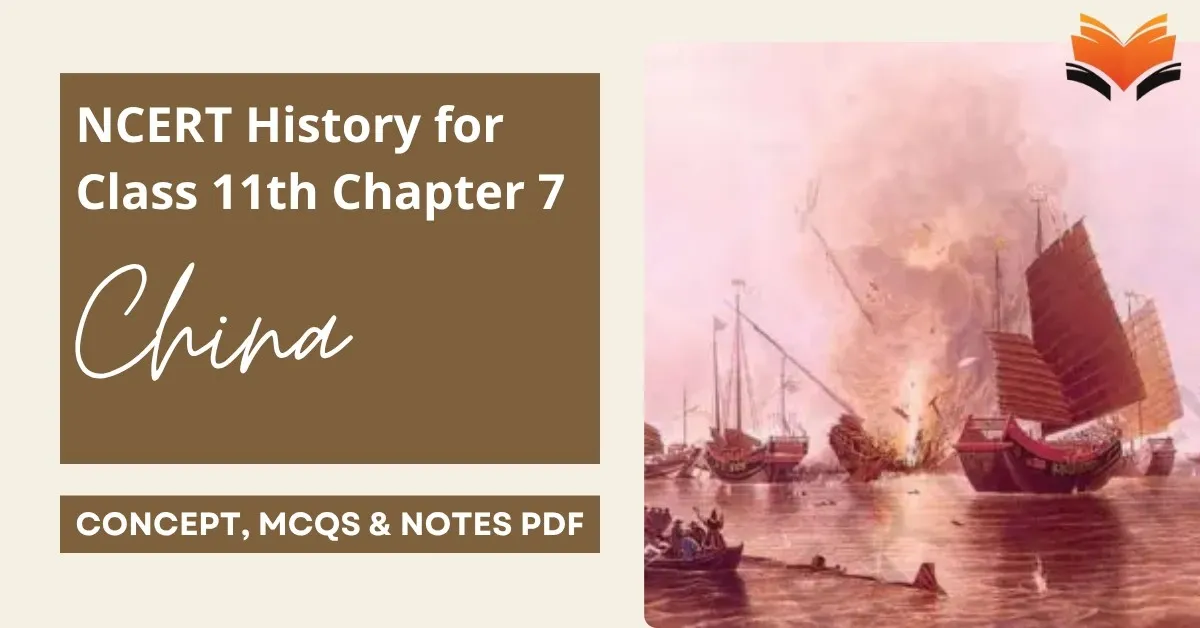
China’s modern history focuses on ending foreign domination, restoring national sovereignty, and achieving equality and development. The weakening of the Qing dynasty after the Opium Wars led to major reforms and the 1911 Revolution, which established a republic under Sun Yat-sen. Later, the Chinese Communist Party (CCP) under Mao Zedong came to power in 1949, introducing socialist reforms, the Great Leap Forward, and the Cultural Revolution. From 1978, Deng Xiaoping launched economic reforms that modernised China while maintaining Communist Party control, transforming it into one of the world’s fastest-growing economies and a major global power.
Topic covered: China class 11 notes, summary, important points and MCQs questions: Paths to Modernisation.
We have discussed in-depth and exam-oriented pointers that can be asked in the board exam of class 11th about “China“ from the NCERT history notes for class 11th chapter 7 “Paths to Modernisation”.
China
1. Modern China: Core Concerns:
- Regaining sovereignty
- Ending humiliation of foreign occupation
- Achieving equality and development
2. Early Reformers:
- Key figures: Kang Youwei, Liang Qichao
- Used traditional ideas in new ways
- Responded to challenges posed by the West
3. Republican Revolutionaries:
- Key figure: Sun Yat-sen
- Inspired by ideas from Japan and the West
- Established the Republic of China
4. Communist Party of China (CCP):
- Aimed to end age-old inequalities
- Wanted to drive out foreigners
5. China’s First Encounter with the West:
- Occurred in 16th–17th centuries
- Jesuit missionaries introduced:
- Astronomy
- Mathematics
- Immediate impact limited but long-term effects significant
6. Expansion of British Trade:
- Britain used force to expand opium trade
- Led to the First Opium War (1839–42)
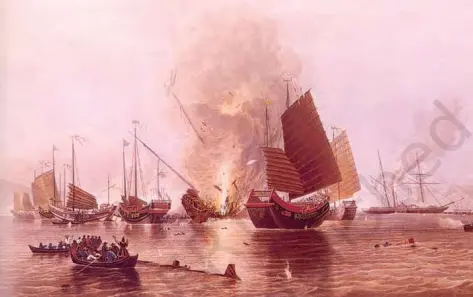
7. Impact of the Opium War:
- Weakened the Qing dynasty
- Strengthened demands for reform and change
8. Administrative and Military Reforms:
- Creation of a modern administrative system
- Establishment of a new army
9. Educational and Political Reforms:
- New education system
- Setting up local assemblies
- Aim to establish constitutional government
10. Fear of Colonisation:
- Colonised countries seen as negative examples
- Poland’s partition widely discussed
- Term ‘to Poland us’ (bolan wo) emerged
- India cited as a warning
11. Nationalism and the Idea of a Nation:
- Liang Qichao stressed national consciousness
- Described India as destroyed by a non-country (East India Company)
- Criticised Indians for:
- Cruelty to their own people
- Subservience to the British
- British use of Indian soldiers in China reinforced fears
12. Confucianism:
- Based on teachings of Confucius
- Focused on:
- Good conduct
- Practical wisdom
- Proper social relations
- Influenced Chinese social and political life
- Later viewed as a barrier to new ideas
13. Educational Transformation:
- Students sent to Japan, Britain and France
- Large number went to Japan in the 1890s
- Many became leading republicans
- Borrowed Japanese translations of European terms:
- Justice
- Rights
- Revolution
- Reversal of traditional cultural influence
14. Abolition of the Examination System (1905):
- Examination based on classical Chinese
- Required writing eight-legged essays
- Very low pass rate
- Produced more degree holders than jobs
- Acted as a barrier to science and technology
- Abolished due to lack of relevance to the modern world
Establishing the Republic (1911)
1. Fall of the Manchu Empire:
- Republic established in 1911
- Leader: Sun Yat-sen
- Regarded as founder of modern China
2. Sun Yat-sen’s Background:
- Came from a poor family
- Studied in missionary schools
- Influenced by democracy and Christianity
Three Principles of Sun Yat-sen (San min chui)
1. Nationalism:
- Overthrow Manchu rule
- End foreign imperialism
2. Democracy:
- Establish democratic government
3. Socialism:
- Regulate capital
- Equalise landholdings
4. May Fourth Movement (1919):
- Protest in Beijing
- Against post-war peace settlement
- China did not regain seized territories
- Became a mass movement
- Attacked tradition
- Promoted:
- Science
- Democracy
- Nationalism
5. Social and Cultural Reforms Advocated:
- Use of simple language
- Abolition of foot-binding
- End subordination of women
- Equality in marriage
- Economic development to reduce poverty
6. Rise of Political Parties:
- Guomindang (GMD)
- Communist Party of China (CCP)
- Both sought national unity and stability
Guomindang under Chiang Kai-shek
1. Political Strategy:
- Military campaigns against warlords
- Suppression of communists
- Emphasis on:
- Militarisation
- Discipline
- Unified behaviour
2. Social Policies:
- Promoted Confucian values
- Restricted women to domestic roles
- Enforced moral codes and dress norms
3. Social Base:
- Primarily urban
- Ignored peasantry
- Industrial growth limited
4. Urban Life and Labour Conditions:
- Industrial working class emerged by 1919
- Shanghai became major industrial centre
- Workers faced:
- Low wages
- Long hours
- Poor working conditions
- Growth of journalism and universities
- Life Weekly reflected new ideas
5. Failure of the Guomindang:
- Narrow social base
- Ignored land reforms
- Did not address inequality
- Relied on military order
The Rise of the Communist Party of China
1. Founding and Ideology:
- Founded in 1921
- Influenced by Russian Revolution
- Mao Zedong emphasised peasantry
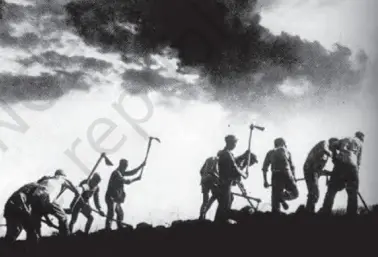
2. Peasant-Based Revolution:
- Jiangxi base (1928–34)
- Land confiscation and redistribution
- Independent army and government
- Support for women’s rights
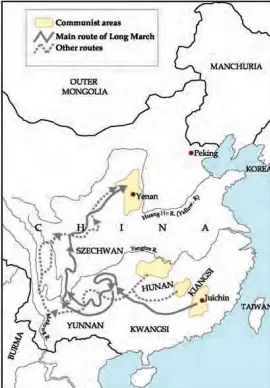
3. The Long March (1934–35):
- Retreat due to Guomindang blockade
- 6,000 miles to Yanan
- Strengthened party base
- Focus on:
- Land reform
- Anti-imperialism
- Ending warlordism
Establishing the New Democracy: 1949-65
1. New Democracy:
- Alliance of all social classes
- Gradual end of private land and enterprise
2. Socialist Transformation:
- Declared in 1953
- Great Leap Forward (1958)
- Creation of people’s communes
- Backyard steel furnaces
- Mass mobilisation
Conflicting Visions (1965–78)
1. Cultural Revolution:
- Launched in 1965
- Targeted old culture and habits
- Red Guards led movement
- Ideology prioritised over expertise
- Caused economic and educational disruption
Reforms from 1978
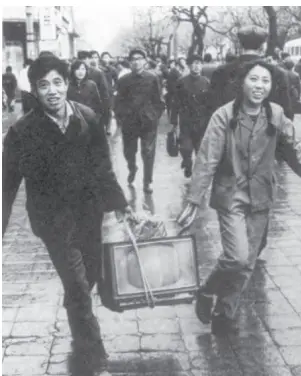
1. Deng Xiaoping’s Policies:
- Socialist market economy
- Four Modernisations:
- Science
- Industry
- Agriculture
- Defence
- Political control retained
2. Democracy Demands:
- Wall-poster: The Fifth Modernisation
- Tiananmen Square protests (1989)
- Suppressed by the state
The Story of Taiwan
1. Formation:
- Chiang Kai-shek fled to Taiwan in 1949
- Established Republic of China
2. Political and Economic Development:
- Initial authoritarian rule
- Land reforms boosted agriculture
- Economy modernised
- Gradual democratisation after 1975
3. China–Taiwan Relations:
- Taiwan considered part of China
- Semi-autonomous status tolerated
- Trade and travel increased
- Reunification remains contentious
China – Exam & Revision Summary
Modern China’s history focuses on restoring national sovereignty, ending foreign domination, and achieving modernisation. Three major groups shaped this process: Reformers (Kang Youwei and Liang Qichao), Republicans led by Sun Yat-sen, and the Communist Party of China (CCP). The First Opium War (1839–42) weakened the Qing Dynasty and increased demands for political and educational reforms. To modernise the country, China abolished its traditional examination system in 1905 and promoted Western education and military reforms.
The Qing Dynasty was overthrown in 1911, and Sun Yat-sen established the Republic of China based on his Three Principles—Nationalism, Democracy, and Socialism. The May Fourth Movement (1919) promoted nationalism, science, democracy, women’s rights, and opposition to foreign imperialism. However, political instability continued under the Guomindang led by Chiang Kai-shek, whose failure to solve peasant problems weakened his government.
The Communist Party of China, founded in 1921, gained support under Mao Zedong, who based the revolution on the peasantry instead of industrial workers. After the Long March (1934–35) and victory in the Chinese Civil War, the CCP established the People’s Republic of China (PRC) in 1949. Mao introduced socialist reforms, the Great Leap Forward (1958), and the Cultural Revolution (1965–76), but these campaigns caused economic disruption and political turmoil.
After Mao’s death, Deng Xiaoping launched the Four Modernisations in 1978 and introduced a Socialist Market Economy, combining economic liberalisation with one-party Communist rule. These reforms transformed China into a major global economic power, although demands for political freedom, highlighted during the Tiananmen Square protests (1989), were suppressed.
After the Communist victory in 1949, Chiang Kai-shek established the Republic of China (Taiwan). Taiwan later became a prosperous democracy through land reforms and industrialisation, while China continues to regard Taiwan as part of its territory.
Quick Revision Points
- First Opium War (1839–42) weakened the Qing Dynasty.
- Chinese examination system abolished – 1905.
- Republic of China established – 1911 under Sun Yat-sen.
- Three Principles: Nationalism, Democracy, Socialism.
- May Fourth Movement (1919) promoted nationalism and modern reforms.
- CCP founded – 1921; Mao Zedong led the Communist Revolution.
- Long March (1934–35) strengthened the CCP.
- People’s Republic of China established – 1949.
- Great Leap Forward (1958) and Cultural Revolution (1965–76) were major Maoist campaigns.
- Deng Xiaoping’s reforms (1978) introduced the Four Modernisations and the Socialist Market Economy.
- Tiananmen Square protests (1989) demanded democracy but were suppressed.
- Taiwan developed into a successful democracy, but China still claims it as its territory.
MCQs on NCERT History Class 11 Chapter 7 Topic – China
Here are the top exam-oriented MCQ-type questions on “China Class 11 history” that you should prepare for your CBSE or state board exams:
Question 1. The central concern of modern Chinese history was
A. Expansion of territory
B. Spread of religion
C. Regaining sovereignty and ending foreign humiliation
D. Industrial supremacy
Answer: C
Question 2. Which of the following was NOT a goal of modern Chinese debates?
A. Equality
B. Development
C. Religious conversion
D. Sovereignty
Answer: C
Question 3. Early reformers in China attempted to
A. Reject all traditions
B. Use traditional ideas in new ways
C. Adopt only Western systems
D. Establish communism
Answer: B
Question 4. Kang Youwei and Liang Qichao belonged to which group?
A. Communist revolutionaries
B. Republican revolutionaries
C. Early reformers
D. Military leaders
Answer: C
Question 5. Sun Yat-sen was inspired mainly by ideas from
A. China alone
B. Japan and the West
C. Soviet Russia
D. Southeast Asia
Answer: B
Question 6. Sun Yat-sen is known as
A. Founder of the CCP
B. Leader of the Qing dynasty
C. First President of the Republic of China
D. Leader of the Red Guards
Answer: C
Question 7. The Communist Party of China aimed to
A. Strengthen monarchy
B. Preserve Confucianism
C. End inequalities and expel foreigners
D. Promote colonial trade
Answer: C
Question 8. China’s first encounter with the West occurred in the
A. Fourteenth century
B. Fifteenth century
C. Sixteenth and seventeenth centuries
D. Nineteenth century
Answer: C
Question 9. Jesuit missionaries introduced which subjects to China?
A. Medicine and law
B. Geography and history
C. Astronomy and mathematics
D. Engineering and chemistry
Answer: C
Question 10. The First Opium War was fought between
A. 1820–22
B. 1839–42
C. 1845–48
D. 1856–60
Answer: B
Question 11. The First Opium War weakened the authority of the
A. Ming dynasty
B. Han dynasty
C. Qing dynasty
D. Tang dynasty
Answer: C
Question 12. Qing reformers wanted to strengthen China by building
A. Religious institutions
B. A modern army and administration
C. Foreign trade monopolies
D. Village councils only
Answer: B
Question 13. The partition of which country deeply influenced Chinese thinkers?
A. India
B. Korea
C. Poland
D. Vietnam
Answer: C
Question 14. The phrase ‘to Poland us’ referred to
A. Economic reform
B. Cultural exchange
C. Colonisation and partition
D. Military alliance
Answer: C
Question 15. Liang Qichao described India as
A. A democratic nation
B. Destroyed by the East India Company
C. A socialist country
D. A military power
Answer: B
Question 16. Confucianism mainly emphasised
A. Scientific reasoning
B. Religious worship
C. Good conduct and social relationships
D. Revolutionary change
Answer: C
Question 17. Confucianism came to be criticised because it
A. Encouraged democracy
B. Supported colonisation
C. Blocked new ideas and institutions
D. Promoted capitalism
Answer: C
Question 18. Many Chinese students went abroad mainly to
A. Escape poverty
B. Learn military skills
C. Study modern subjects
D. Spread Confucianism
Answer: C
Question 19. Most Chinese students in the 1890s went to
A. Britain
B. France
C. Japan
D. Germany
Answer: C
Question 20. The Chinese borrowed Japanese translations of European words because
A. Japan ruled China
B. Both used the same ideographic script
C. Europe forced them
D. China lacked a language
Answer: B
Question 21. The Chinese examination system was abolished in
A. 1895
B. 1900
C. 1905
D. 1911
Answer: C
Question 22. The Chinese examination system mainly tested
A. Scientific knowledge
B. Military skills
C. Literary skills
D. Technical expertise
Answer: C
Question 23. The Republic of China was established in
A. 1905
B. 1911
C. 1919
D. 1921
Answer: B
Question 24. Sun Yat-sen’s political programme was called
A. New Democracy
B. Five Loves
C. Three Principles
D. Four Modernisations
Answer: C
Question 25. Nationalism in Sun Yat-sen’s programme meant
A. Economic planning
B. Overthrow of the Manchu dynasty
C. Land redistribution
D. Cultural revival
Answer: B
Question 26. The May Fourth Movement began in
A. 1911
B. 1915
C. 1919
D. 1925
Answer: C
Question 27. The May Fourth Movement emphasised
A. Tradition and religion
B. Science, democracy and nationalism
C. Military discipline
D. Confucian ethics
Answer: B
Question 28. The CCP was founded in
A. 1911
B. 1919
C. 1921
D. 1927
Answer: C
Question 29. Mao Zedong based his revolutionary strategy mainly on
A. Urban workers
B. Industrial capitalists
C. Peasantry
D. Foreign aid
Answer: C
Question 30. The Long March took place during
A. 1921–23
B. 1928–30
C. 1934–35
D. 1937–39
Answer: C
Question 31. The People’s Republic of China was established in
A. 1937
B. 1945
C. 1949
D. 1953
Answer: C
Question 32. The Great Leap Forward was launched in
A. 1953
B. 1956
C. 1958
D. 1965
Answer: C
Question 33. The Cultural Revolution was launched in
A. 1958
B. 1962
C. 1965
D. 1978
Answer: C
Question 34. The Four Modernisations aimed to develop
A. Religion, culture, society, politics
B. Agriculture, industry, science, defence
C. Democracy, equality, justice, rights
D. Trade, transport, tourism, technology
Answer: B
Question 35. The Tiananmen Square protests occurred in
A. 1975
B. 1978
C. 1989
D. 1995
Answer: C
Question 36. Chiang Kai-shek fled to Taiwan in
A. 1937
B. 1945
C. 1949
D. 1953
Answer: C
Question 37. Taiwan was a Japanese colony after the
A. Sino-Japanese War of 1894–95
B. Russo-Japanese War
C. First World War
D. Second World War
Answer: A
Question 38. Martial law in Taiwan was lifted in
A. 1975
B. 1980
C. 1987
D. 1991
Answer: C
Question 39. Most countries maintain only trade missions in Taiwan because
A. Taiwan is poor
B. Taiwan is hostile
C. Taiwan is considered part of China
D. Taiwan refuses diplomacy
Answer: C
Question 40. China may tolerate Taiwan as long as it
A. Joins NATO
B. Becomes communist
C. Gives up independence
D. Ends trade with China
Answer: C
Next & Previous Topics of NCERT/CBSE History Class 11 Chapter 7: Paths to Modernisation
| Topics No. | Topics Name |
|---|---|
| 1 | Japan |
| 2 | China |
| 3 | The Story of Korea |
| 4 | Two Roads to Modernisation |
FAQs on China Class 11 History
1. What is the modern history of China mainly about?
Answer: The modern history of China focuses on regaining national sovereignty, ending foreign domination, achieving equality, and promoting economic and political development. Different groups, including reformers, republicans, and communists, proposed different paths to modernize China and protect it from foreign influence. These efforts shaped China’s transformation from the Qing dynasty to a modern socialist state.
2. What caused the First Opium War, and what were its effects on China?
Answer: The First Opium War (1839–1842) was caused by Britain’s expansion of the opium trade in China despite Chinese efforts to stop it. China’s defeat weakened the Qing dynasty, increased foreign control through unequal treaties, and exposed the country’s military and administrative weaknesses. The war also accelerated demands for political, educational, and military reforms.
3. Why was the Chinese examination system abolished in 1905?
Answer: The traditional Chinese examination system was abolished in 1905 because it focused mainly on classical literature rather than modern science, technology, and administration. Reformers believed it prevented modernization and failed to prepare officials for the challenges posed by Western powers. Its abolition marked an important step toward educational reform.
4. Who was Sun Yat-sen, and what were his Three Principles?
Answer: Sun Yat-sen was the founder of modern China and the first president of the Republic of China, established in 1911. His political philosophy, known as the Three Principles of the People, included Nationalism (ending foreign domination and overthrowing the Qing dynasty), Democracy (establishing representative government), and Socialism (regulating capital and equalising land ownership). These principles guided China’s early republican movement.
5. What was the May Fourth Movement, and why is it considered a turning point in Chinese history?
Answer: The May Fourth Movement began on 4 May 1919 as a student protest against the decisions of the Paris Peace Conference. It soon developed into a nationwide movement promoting nationalism, democracy, science, and social reforms. It challenged traditional ideas, encouraged modern education and literature, strengthened anti-imperialist sentiments, and inspired the rise of revolutionary movements, including the Communist Party of China.
6. Why did the Guomindang fail to establish a stable government in China?
Answer: The Guomindang failed because it had a narrow urban support base, neglected peasants, failed to implement land reforms, and relied heavily on military force rather than addressing social and economic problems. Rising inequality, corruption, and continued political instability reduced public support and ultimately allowed the Communist Party to gain power.
7. How did Mao Zedong help the Communist Party of China come to power?
Answer: Mao Zedong transformed the Communist Party by focusing on the peasantry instead of urban workers. He introduced land redistribution, organized peasant support, promoted women’s rights, and strengthened rural revolutionary bases such as Jiangxi and Yan’an. His leadership during the Long March and the war against Japan helped the Communist Party gain widespread support, leading to the establishment of the People’s Republic of China in 1949.
8. What were the Great Leap Forward and the Cultural Revolution, and how did they affect China?
Answer: The Great Leap Forward (1958) aimed to rapidly industrialize China through people’s communes and backyard steel production, but it largely failed due to poor planning and inefficient production. The Cultural Revolution (1965–1976) was launched by Mao Zedong to strengthen communist ideology and eliminate old customs and ideas. It caused political instability, disrupted education and the economy, and led to the persecution of intellectuals and political opponents.
9. What reforms did Deng Xiaoping introduce after 1978, and how did they transform China?
Answer: After 1978, Deng Xiaoping introduced the Four Modernisations in agriculture, industry, science and technology, and national defence. He promoted a socialist market economy, encouraged foreign investment, modernized industries, and integrated China into the global economy while maintaining Communist Party rule. These reforms transformed China into one of the world’s fastest-growing economies.
10. Why is Taiwan important in modern Chinese history?
Answer: Taiwan became the base of the Republic of China after Chiang Kai-shek and the Guomindang retreated there following their defeat by the Communist Party in 1949. Over time, Taiwan developed into a prosperous democracy with a strong economy. However, mainland China continues to regard Taiwan as part of its territory, making the Taiwan issue one of the most significant and unresolved political questions in modern Chinese history.