
Topic & sub-topics covered: What Development Promises – Different People, Different Goals: Development (All single detail notes are exam-oriented).
We have discussed in-depth and exam-oriented pointers that can be asked in the board exam of class 10th about “What Development Promises – Different People, Different Goals” which is taken from the NCERT Economics for class 10th chapter no. 1 “Development“.
Download NCERT Economics Chapter 1 Class 10th Notes PDF for “Development”
Embark on a journey to understand the intricate dynamics of economic development with NCERT Economics Chapter 1 Class 10th Notes. Delving into the essence of “Development,” these notes offer a comprehensive overview of key concepts, theories, and real-world examples.
Download NCERT Class 10 Economics Chapter 1 Notes Development Economics Class 10 Chapter 1 Notes PDF
Available in PDF format, these notes provide a convenient and accessible resource for Class 10th students to enhance their understanding, facilitate revision, and excel in their studies. Download NCERT Economics Chapter 1 Class 10th Notes PDF now and unlock the keys to comprehending the dynamics of development in the global context.
What Development Promises – Different People, Different Goals
1. Understanding Development Aspirations:
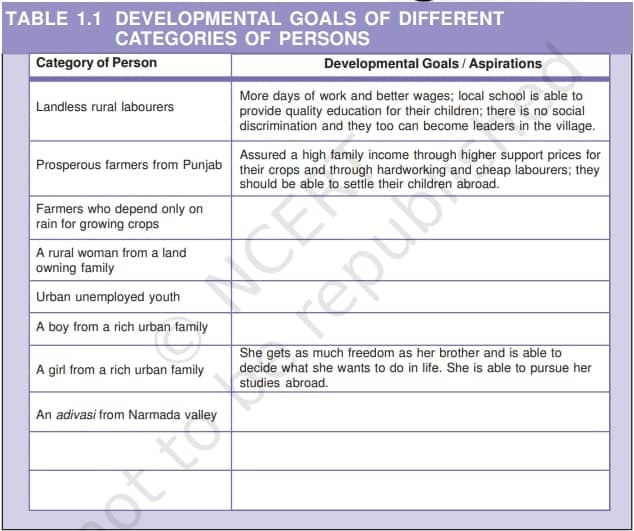
- Development or progress holds different meanings for individuals listed in Table 1.1.
- Aspirations vary based on personal circumstances, needs, and desires.
2. Diverse Notions of Development:
- Each person seeks things that are most important to them, reflecting their unique priorities.
- Conflicting aspirations may arise between individuals or groups, leading to differing views on development.
3. Example of Conflicting Aspirations:
- Conflicts in aspirations can arise within families, such as between a girl and her brother regarding gender roles and responsibilities.
- Similarly, conflicts can emerge at societal levels, such as between industrialists advocating for large dams and tribals opposing them due to displacement concerns.
4. Development Subjectivity:
- Development goals are subjective and context-dependent, differing from person to person.
- What may be considered development for one individual or group may not align with the aspirations or interests of others.
Next & Previous Topics of NCERT/CBSE Economics Class 10 Chapter 1: Development
MCQs on NCERT Economics Class 10 Chapter 1 Topic – What Development Promises – Different People, Different Goals Class 10
Here are top exam oriented mcq’s type questions on “What Development Promises – Different People, Different Goals class 10” that you should prepare for your CBSE or state board exams:
Question 1. Development means the same thing for:
A) All people
B) Only rich people
C) Different people differently
D) Only governments
Answer: C
Question 2. Development aspirations depend on:
A) Government policies only
B) Personal circumstances and needs
C) Only income
D) Only education
Answer: B
Question 3. What people consider development is based on their:
A) Religion
B) Priorities
C) Age
D) Location
Answer: B
Question 4. Development goals may differ because:
A) People are similar
B) People have same needs
C) People have different desires
D) People have no goals
Answer: C
Question 5. Conflicting development goals can occur:
A) Only in villages
B) Only in cities
C) Between individuals or groups
D) Only in families
Answer: C
Question 6. An example of conflict in development goals is:
A) Same job preference
B) Same income level
C) Different views on gender roles
D) Same education
Answer: C
Question 7. Conflict between industrialists and tribals is mainly about:
A) Education
B) Religion
C) Large dams and displacement
D) Food
Answer: C
Question 8. Industrialists generally support:
A) Small houses
B) Forest protection only
C) Large dams
D) Tribal rights only
Answer: C
Question 9. Tribals often oppose large dams because of:
A) Lack of interest
B) Displacement
C) Education issues
D) Employment
Answer: B
Question 10. Development is considered:
A) Objective
B) Fixed
C) Subjective
D) Universal
Answer: C
Question 11. Subjective nature of development means:
A) Same for all
B) Depends on individual perspective
C) Based on laws only
D) Based on economy only
Answer: B
Question 12. What may be development for one may not be for another because:
A) Everyone is equal
B) Needs and interests differ
C) People follow same goals
D) Laws are same
Answer: B
Question 13. Development goals can conflict within:
A) Only society
B) Only government
C) Families also
D) Only industries
Answer: C
Question 14. Development is linked to:
A) Only income
B) Only education
C) Individual aspirations
D) Only politics
Answer: C
Question 15. The concept of development highlights:
A) Uniform goals
B) Diversity of goals
C) Only economic growth
D) Only social change
Answer: B
Question 16. Different people want different things because of:
A) Same lifestyle
B) Same income
C) Different situations
D) Same culture
Answer: C
Question 17. Conflicting goals show that development is:
A) Simple
B) Clear
C) Complex
D) Fixed
Answer: C
Question 18. Development is not:
A) Dynamic
B) Flexible
C) One-dimensional
D) Multi-dimensional
Answer: C
Question 19. Which factor influences development goals?
A) Needs
B) Desires
C) Circumstances
D) All of these
Answer: D
Question 20. The main idea of development in this context is:
A) Same for everyone
B) Based on government only
C) Different for different people
D) Only economic growth
Answer: C
FAQs on “What Development Promises – Different People, Different Goals”
Q1. What topics are covered in NCERT Economics Class 10 notes on “What Development Promises – Different People, Different Goals”?
Answer: The notes cover various sub-topics, including understanding development aspirations, diverse notions of development, examples of conflicting aspirations, and the subjectivity of development goals.
Q2. How do these notes cater to Class 10th board exam requirements?
Answer: These notes provide exam-oriented pointers derived from the NCERT Economics for Class 10, Chapter 1, ensuring students are well-prepared to answer questions related to “What Development Promises – Different People, Different Goals” in their board exams.
Q3. Are these notes suitable for self-study and exam preparation?
Answer: Yes, these notes are designed to facilitate self-study and exam preparation for Class 10 Economics students. They offer exam-oriented pointers and comprehensive coverage to aid students in their studies.