
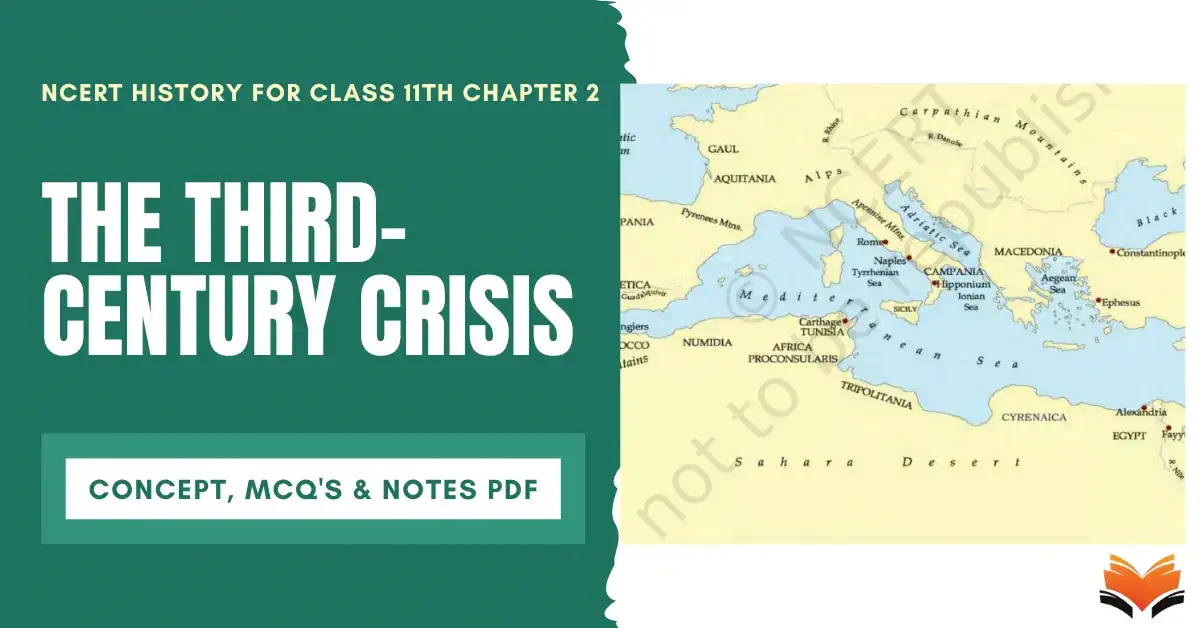
The Third-Century Crisis Class 11 – Concept, MCQs & Notes PDF
Topic covered: The Third-Century Crisis class 11 notes and MCQs questions: An Empire Across Three Continents (All single detail notes are exam-oriented).
We have discussed in-depth and exam-oriented pointers that can be asked in the board exam of class 11th about “The Third-Century Crisis“ from the NCERT history notes for class 11th chapter 2 “An Empire Across Three Continents”.
Download the NCERT History for Class 11th Chapter 2 An Empire Across Three Continents Notes PDF
NCERT History Class 11 Chapter 2 notes are prepared to help students study more effectively and revise faster. This chapter, An Empire Across Three Continents, introduces to the rise and expansion of a powerful empire that spread across Asia, Europe, and Africa, shaping political, cultural, and administrative systems. This chapter plays an important role in building a strong foundation in Class 11 History.
At E-book NCERT, the Class 11 History Chapter 2 notes are created to support focused and exam-oriented study. Students can download the NCERT History notes PDF anytime for quick revision and better understanding. This chapter explores the growth of a vast empire, its administration, economy, military organisation, and cultural integration across three continents. It also discusses important archaeological and literary sources that help us understand how such empires functioned and influenced the ancient world.
The Third-Century Crisis
1. Contrast Between Early Centuries:
- First and second centuries were marked by peace, prosperity, and economic expansion.
- Third century signaled the beginning of internal strain within the empire.
2. External Pressures on the Empire:
- From the 230s, Rome had to fight on multiple fronts at the same time.
- A new aggressive Iranian dynasty, the Sasanians, emerged in 225.
3. Rise of the Sasanians:
- Sasanians expanded rapidly towards the Euphrates within 15 years of their rise.
- Shapur I claimed to have destroyed a Roman army of 60,000.
- He also claimed to have captured Antioch, the eastern Roman capital.
- His achievements were recorded in a trilingual rock inscription.
4. Germanic Tribal Attacks:
- Several Germanic tribal confederacies attacked Roman frontiers.
- Key groups included the Alamanni, the Franks, and the Goths.
- Invasions occurred repeatedly from 233 to 280.
- Affected regions stretched from the Black Sea to the Alps and southern Germany.
5. Roman Territorial Losses:
- Rome had to give up large areas beyond the Danube.
- Emperors spent much of their time in military campaigns against groups they called “barbarians.”
6. Political Instability:
- Rapid change of rulers indicated severe internal stress.
- 25 emperors ruled in just 47 years during the third century.
Next & Previous Topics of NCERT/CBSE History Class 11 Chapter 2: An Empire Across Three Continents
| Topics No. | Topics Name |
|---|---|
| 1 | The Early Empire |
| 2 | The Third-Century Crisis |
| 3 | Gender, Literacy, Culture |
| 4 | Economic Expansion |
| 5 | Controlling Workers |
| 6 | Social Hierarchies |
| 7 | Late Antiquity |
MCQs on NCERT History Class 11 Chapter 2 Topic – The Third-Century Crisis Class 11
Here are the top exam-oriented MCQ-type questions on “The Third-Century Crisis Class 11” that you should prepare for your CBSE or state board exams:
Question 1. The first and second centuries of the Roman Empire are described as a period of:
a) Continuous warfare
b) Political instability
c) Peace, prosperity and economic expansion
d) Administrative decline
Answer: c) Peace, prosperity and economic expansion
Question 2. The first major signs of internal strain in the Roman Empire appeared in the:
a) Second century
b) Early third century
c) Late third century
d) Fourth century
Answer: b) Early third century
Question 3. From which decade did the Roman Empire start fighting on several fronts simultaneously?
a) 210s
b) 220s
c) 230s
d) 240s
Answer: c) 230s
Question 4. A new aggressive dynasty emerged in Iran in:
a) 200 CE
b) 215 CE
c) 225 CE
d) 250 CE
Answer: c) 225 CE
Question 5. The Iranian dynasty that emerged in 225 CE called themselves the:
a) Parthians
b) Achaemenids
c) Seleucids
d) Sasanians
Answer: d) Sasanians
Question 6. Within how many years did the Sasanians expand rapidly towards the Euphrates?
a) 5 years
b) 10 years
c) 15 years
d) 25 years
Answer: c) 15 years
Question 7. Which Iranian ruler claimed to have defeated a Roman army of 60,000?
a) Ardashir I
b) Shapur I
c) Xerxes
d) Darius
Answer: b) Shapur I
Question 8. Shapur I made his claim in a rock inscription written in:
a) One language
b) Two languages
c) Three languages
d) Four languages
Answer: c) Three languages
Question 9. According to Shapur I, which Roman city was captured by the Sasanians?
a) Rome
b) Alexandria
c) Antioch
d) Carthage
Answer: c) Antioch
Question 10. The Roman city of Antioch was the:
a) Western capital
b) Religious centre
c) Eastern capital
d) Trade outpost
Answer: c) Eastern capital
Question 11. Which groups moved against the Rhine and Danube frontiers?
a) Persian armies
b) Nomadic tribes
c) Germanic tribal confederacies
d) Celtic clans
Answer: c) Germanic tribal confederacies
Question 12. Which of the following was NOT mentioned as a Germanic group?
a) Alamanni
b) Franks
c) Goths
d) Huns
Answer: d) Huns
Question 13. The period from 233 to 280 CE was marked by:
a) Administrative reforms
b) Peace treaties
c) Repeated invasions
d) Cultural expansion
Answer: c) Repeated invasions
Question 14. The invasions affected provinces stretching from:
a) Spain to Italy
b) Britain to Gaul
c) Black Sea to the Alps and southern Germany
d) Egypt to Syria
Answer: c) Black Sea to the Alps and southern Germany
Question 15. During this period, the Romans were forced to abandon territories beyond the:
a) Rhine
b) Alps
c) Euphrates
d) Danube
Answer: d) Danube
Question 16. Roman emperors of the third century were mostly:
a) Governing from Rome
b) Engaged in administration
c) Constantly in the field
d) Focused on trade
Answer: c) Constantly in the field
Question 17. The Romans referred to their external enemies as:
a) Invaders
b) Foreigners
c) Barbarians
d) Nomads
Answer: c) Barbarians
Question 18. The rapid succession of emperors in the third century indicates:
a) Strong leadership
b) Political stability
c) Internal strain
d) Economic growth
Answer: c) Internal strain
Question 19. How many emperors ruled in the Roman Empire during the 47 years of the third century crisis?
a) 10
b) 15
c) 20
d) 25
Answer: d) 25
Question 20. The rule of 25 emperors in 47 years mainly reflects:
a) Efficient governance
b) Expansion of empire
c) Political instability
d) Cultural diversity
Answer: c) Political instability
Question 21. Which frontier regions faced maximum pressure during the third century?
a) Nile and Red Sea
b) Rhine and Danube
c) Tigris and Euphrates
d) Alps and Pyrenees
Answer: b) Rhine and Danube
Question 22. The third century crisis was marked by all EXCEPT:
a) External invasions
b) Rapid change of emperors
c) Military pressure on frontiers
d) Complete economic collapse
Answer: d) Complete economic collapse
Question 23. The Sasanians were more aggressive than the earlier Iranian rulers because they:
a) Avoided warfare
b) Expanded rapidly westwards
c) Focused on trade
d) Allied with Rome
Answer: b) Expanded rapidly westwards
Question 24. The third century crisis mainly began due to:
a) Religious conflicts
b) Multiple simultaneous wars
c) Decline in trade
d) Urban revolts
Answer: b) Multiple simultaneous wars