
The Revival of Italian Cities Class 11 – Concept, MCQs & Notes PDF
Topic covered: The Revival of Italian Cities class 11 notes and MCQs questions: Changing Cultural Traditions (All single detail notes are exam-oriented).
We have discussed in-depth and exam-oriented pointers that can be asked in the board exam of class 11th about “The Revival of Italian Cities“ from the NCERT history notes for class 11th chapter 5 “Changing Cultural Traditions”.
Download the NCERT History for Class 11th Chapter 5 Changing Cultural Traditions Notes PDF
Download the NCERT History for Class 11th Chapter 5 Changing Cultural Traditions Notes PDF if you want a clear and readable explanation of how ideas, art, and knowledge began to change in medieval Europe. These notes walk you through the revival of Italian cities, the growth of universities, and the rise of humanism, showing how people started to look at history, science, and philosophy in new ways. You will also learn about the Arab contribution to knowledge, realistic art, architecture, the first printed books, and changing views about human beings and women. The chapter ends with important religious debates and scientific ideas like the Copernican Revolution, helping you understand how people began to read and interpret the universe differently.
The Revival of Italian Cities
1. Decline of Italian Towns after Roman Empire:
- Fall of the western Roman Empire led to decline
- Many Italian towns that were:
- Political centres
- Cultural centres
2. Absence of Political Unity:
- No unified government in Italy
- The Pope in Rome:
- Sovereign in his own state
- Not a strong political figure
3. Italy’s Position in Medieval Europe:
- Western Europe:
- Reshaped by feudal bonds
- Unified under the Latin Church
- Eastern Europe: United under the Byzantine Empire
- Islam: Created a common civilisation further west
- Italy: Weak and fragmented
4. Conditions Leading to Cultural Revival:
- Fragmentation indirectly helped revival
- Expansion of trade between:
- Byzantine Empire
- Islamic countries
- Revival of Italian coastal ports
5. Growth of Trade and Italian Towns:
- From the twelfth century:
- Mongols opened trade with China via Silk Route
- Trade with western Europe increased
- Italian towns began to play a central role in trade
6. Emergence of Independent City-States:
- Italian towns no longer saw themselves as part of an empire
- They became independent city-states
7. Types of Italian City-States:
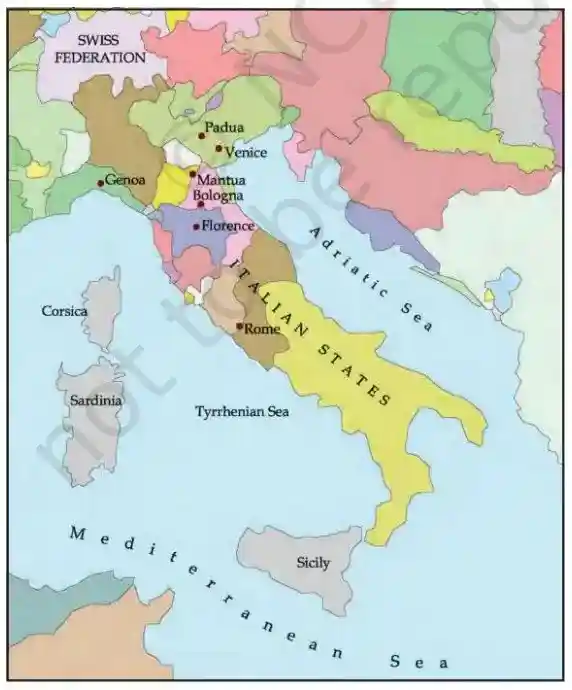
- Florence and Venice: Republics
- Other towns:
- Court-cities
- Ruled by princes
8. Major Italian Cities:
- Venice: One of the most vibrant cities
- Genoa: Another major city
9. Distinct Political Structure of Italian Cities:
- Clergy: Not politically dominant
- Feudal lords: Not powerful
- Power lay with:
- Rich merchants
- Bankers
10. Role of Merchants and Bankers:
- Actively participated in: Governing the city
- Helped the idea of citizenship take root
11. Civic Pride and Citizenship:
- Even under military despots: Pride in being citizens remained strong
- Sense of citizenship did not weaken
The City-State
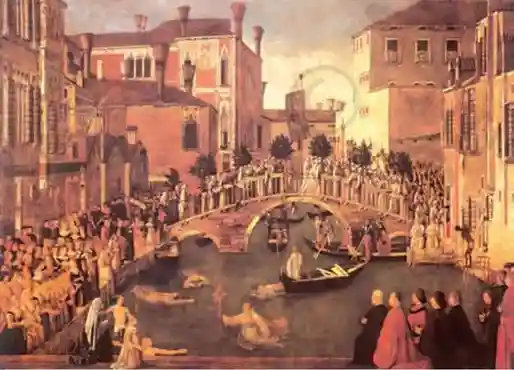
1. The City-State of Venice:
- Venice described as a commonwealth
- Authority rested in a council
- Council membership:
- All gentlemen of the city
- Above the age of 25 years
2. Exclusion of Common People:
- Common people not admitted to governing council
- Reason: Fear of disorder and popular tumults
3. Basis of Political Authority:
- Governance not based on: Wealth alone
- Defined by: Nobility of lineage
- Also included: Citizens ennobled by virtue
4. Balanced Political System:
- Supreme nobility did not rule alone
- Power shared among:
- Nobly born citizens
- Virtuous citizens
- Prevented rule by: A few individuals
5. Nature of Venetian Government:
- Combination of:
- Nobility
- Merit
- Reflected a republican tradition
The 14th and 15th Centuries:
1300 – Humanism taught at Padua University in Italy
1341 – Petrarch given the title of “Poet Laureate” in Rome
1349 – University established in Florence
1390 – Geoffrey Chaucer’s Canterbury Tales published
1436 – Brunelleschi designs the Duomo in Florence
1453 – Ottoman Turks defeat the Byzantine ruler of Constantinople
1454 – Gutenberg prints the Bible with movable type
1484 – Portuguese mathematicians calculate latitude by observing the sun
1492 – Columbus reaches America
1495 – Leonardo da Vinci paints The Last Supper
1512 – Michelangelo paints the Sistine Chapel ceiling
Next & Previous Topics of NCERT/CBSE History Class 11 Chapter 5: Changing Cultural Traditions
MCQs on NCERT History Class 11 Chapter 5 – The Revival of Italian Cities Class 11
Here are the top exam-oriented MCQ-type questions on “The Revival of Italian Cities Class 11” that you should prepare for your CBSE or state board exams:
Question 1. After the fall of the Western Roman Empire, many Italian towns:
A. Became trade centres
B. Emerged as republics
C. Fell into ruin
D. Became capitals of empires
Answer: C
Question 2. Which factor weakened Italy politically after the Roman Empire fell?
A. Strong monarchy
B. Unified government
C. Absence of a unified state
D. Powerful feudal system
Answer: C
Question 3. The Pope in Rome was:
A. A powerful European ruler
B. Sovereign of his own state but politically weak
C. Head of a unified empire
D. Supreme feudal lord
Answer: B
Question 4. Western Europe was unified mainly under the:
A. Byzantine Empire
B. Holy Roman Empire
C. Latin Church
D. Islamic Caliphate
Answer: C
Question 5. Eastern Europe was unified under the:
A. Latin Church
B. Islamic civilisation
C. Byzantine Empire
D. Feudal lords
Answer: C
Question 6. Islam helped create a common civilisation mainly in:
A. Eastern Europe
B. Northern Europe
C. Western regions
D. Central Italy
Answer: C
Question 7. Italy remained weak and fragmented mainly because:
A. It lacked trade
B. It had strong feudal lords
C. It was not politically unified
D. It followed the Latin Church
Answer: C
Question 8. The revival of Italian culture was helped by:
A. Political unity
B. Feudal stability
C. Trade expansion
D. Agricultural reforms
Answer: C
Question 9. Trade between the Byzantine Empire and Islamic countries led to the revival of:
A. Inland towns
B. Hill settlements
C. Italian coastal ports
D. Rural villages
Answer: C
Question 10. From the twelfth century, trade with China increased mainly due to:
A. Sea routes
B. Mongol expansion
C. Crusades
D. Roman roads
Answer: B
Question 11. The Silk Route connected Europe with:
A. Africa
B. America
C. China
D. Australia
Answer: C
Question 12. Italian towns played a central role because they:
A. Controlled the Church
B. Were part of a large empire
C. Linked eastern and western trade
D. Had strong feudal armies
Answer: C
Question 13. Italian towns began to see themselves as:
A. Feudal kingdoms
B. Provinces of empires
C. Independent city-states
D. Religious centres
Answer: C
Question 14. Florence and Venice were examples of:
A. Monarchies
B. Theocracies
C. Republics
D. Feudal estates
Answer: C
Question 15. Many Italian city-states were court-cities ruled by:
A. Bishops
B. Merchants
C. Princes
D. Peasants
Answer: C
Question 16. Which of the following cities is described as one of the most vibrant?
A. Rome
B. Florence
C. Venice
D. Milan
Answer: C
Question 17. Genoa and Venice were important mainly because of their:
A. Agricultural wealth
B. Military power
C. Trade and ports
D. Religious authority
Answer: C
Question 18. Italian cities differed from the rest of Europe because:
A. Kings ruled directly
B. Clergy dominated politics
C. Feudal lords were powerful
D. Clergy were not politically dominant
Answer: D
Question 19. In Italian city-states, powerful feudal lords were:
A. Dominant
B. Moderately influential
C. Largely absent
D. Supreme rulers
Answer: C
Question 20. Governance in Italian cities involved active participation of:
A. Peasants
B. Clergy
C. Merchants and bankers
D. Feudal knights
Answer: C
Question 21. The participation of merchants helped develop the idea of:
A. Monarchy
B. Citizenship
C. Feudal loyalty
D. Serfdom
Answer: B
Question 22. Even under military despots, townspeople continued to feel pride in being:
A. Subjects
B. Soldiers
C. Citizens
D. Clergy
Answer: C
Question 23. Cardinal Gasparo Contarini wrote about Venice’s government in:
A. 1490
B. 1501
C. 1534
D. 1600
Answer: C
Question 24. According to Contarini, the highest authority in Venice rested with:
A. The Prince
B. The Pope
C. The Council
D. The Army
Answer: C
Question 25. Membership of the Venetian council was limited to:
A. All adults
B. Common people
C. Gentlemen above 25 years
D. Clergy only
Answer: C
Question 26. Common people were excluded from the council mainly to avoid:
A. Foreign invasion
B. Economic decline
C. Popular tumults
D. Religious conflict
Answer: C
Question 27. Some people believed government should be based on:
A. Wealth alone
B. Military rank
C. Birth and virtue
D. Religion
Answer: A
Question 28. The ancestors of Venice rejected rule based only on wealth because:
A. Rich citizens were few
B. Wealth was unstable
C. Poor but capable citizens would be excluded
D. Trade was declining
Answer: C
Question 29. Venetian political rights were based mainly on:
A. Wealth
B. Nobility of lineage
C. Popular vote
D. Religious status
Answer: B
Question 30. Venetian governance tried to avoid rule by:
A. Nobility
B. Common people
C. A few elite families alone
D. Merchants
Answer: C
Question 31. Italian city-states encouraged early ideas of:
A. Absolutism
B. Citizenship and civic pride
C. Serfdom
D. Feudal loyalty
Answer: B
Question 32. The political weakness of Italy ironically contributed to:
A. Its decline
B. Cultural stagnation
C. Cultural revival
D. Religious dominance
Answer: C
Question 33. Italian cities prospered mainly because of their role in:
A. Agriculture
B. Feudal warfare
C. Long-distance trade
D. Church administration
Answer: C
Question 34. Which group had the least political dominance in Italian cities?
A. Merchants
B. Bankers
C. Clergy
D. Nobles
Answer: C
Question 35. The passage mainly explains the rise of:
A. Feudal monarchies
B. Italian nationalism
C. Italian city-states and civic culture
D. Religious reform movements
Answer: C
Question 36. Pride in citizenship survived even under:
A. Monarchies
B. Military despots
C. Feudal lords
D. The Church
Answer: B
Question 37. Which factor most clearly distinguishes Italian cities from feudal Europe?
A. Use of Latin
B. Role of citizenship
C. Agricultural surplus
D. Military organisation
Answer: B
Question 38. The revival of Italian towns began mainly after the:
A. 10th century
B. 11th century
C. 12th century
D. 14th century
Answer: C
Question 39. Trade links helped Italian towns emerge as:
A. Empires
B. Religious capitals
C. Independent political units
D. Rural centres
Answer: C
Question 40. The overall theme of the passage highlights:
A. Collapse of Europe
B. Rise of feudalism
C. Urban revival and civic government in Italy
D. Spread of Christianity
Answer: C