
Monks Class 11 – Concept, MCQs & Notes PDF
Topic covered: Monks class 11 notes and MCQs questions: The Three Orders (All single detail notes are exam-oriented).
We have discussed in-depth and exam-oriented pointers that can be asked in the board exam of class 11th about “Monks“ from the NCERT history notes for class 11th chapter 4 “The Three Orders”.
Download the NCERT History for Class 11th Chapter 4 The Three Orders Notes PDF
Download the NCERT History for Class 11th Chapter 4 The Three Orders Notes PDF for a detailed and easy-to-understand explanation of medieval European society. These notes begin with an introduction to feudalism and explain how the feudal system developed in France and England. You will clearly understand the three orders of society, focusing on the second order, the nobility, their privileges, duties, and life on the manorial estate, including the role of knights in feudal warfare.
The chapter also explains the first order, the clergy, covering monks, the Church, and its deep influence on social life, education, and moral values. Equal attention is given to the third order, peasants, both free and unfree, with specific references to England and their everyday struggles. In addition, the notes discuss factors affecting social and economic relations, the emergence of a possible fourth order with new towns, townspeople, and cathedral towns, and the major crisis of the fourteenth century, marked by social unrest and political changes. These NCERT-based notes are ideal for concept clarity, revision, and exam preparation.
Monks
1. Alternative Religious Organisation:
- Apart from the Church, devout Christians formed another religious organisation.
- Some deeply religious people chose to live isolated lives.
- This was in contrast to clerics living in towns and villages.
2. Abbeys and Monasteries:
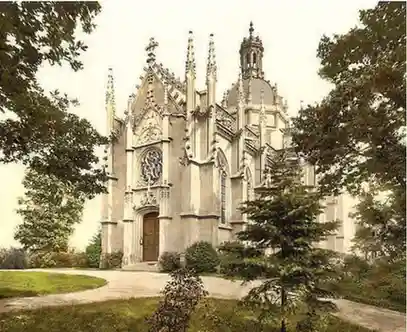
- Religious communities were called abbeys or monasteries.
- They were often located far from human habitation.
- Famous monasteries:
- St Benedict’s monastery, Italy (529)
- Cluny monastery, Burgundy (910)
3. Vows and Daily Life of Monks:
- Monks took vows to:
- Stay in the abbey for life
- Spend time in prayer, study and manual labour
- Manual labour included farming.
4. Men and Women in Monastic Life:
- Monastic life was open to both men and women.
- Men became monks and women became nuns.
- Most abbeys were single-sex communities.
- Monks and nuns did not marry.
5. Growth of Monasteries:
- Early monasteries had 10–20 members.
- Later, communities grew to several hundred.
- Monasteries had:
- Large buildings
- Landed estates
- Schools or colleges
- Hospitals
6. Contribution to Arts and Music:
- Monasteries contributed to the development of the arts.
- Abbess Hildegard was a gifted musician.
- She promoted community singing of prayers in church.
7. Friars:
- From the thirteenth century, some monks were called friars.
- Friars:
- Did not live in monasteries
- Moved from place to place
- Preached to people
- Lived on charity
8. Criticism of Monasticism:
- By the fourteenth century, doubts arose about monastic life.
- Langland’s Piers Plowman (c.1360–70):
- Criticised luxury of monks
- Praised simple labourers’ faith
- Chaucer’s Canterbury Tales:
- Gave comic portraits of a nun, monk and friar
9. Rules of Benedictine Monasteries:
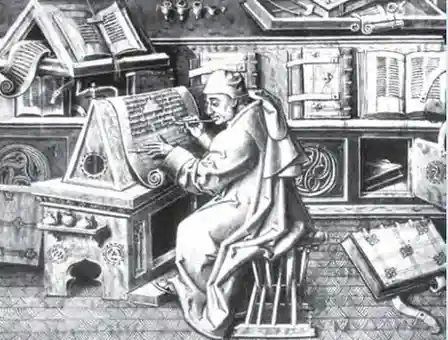
- Benedictine monasteries followed a manuscript of 73 chapters.
- Key rules included:
- Rare permission to speak (Chapter 6)
- Obedience as humility (Chapter 7)
- No private property (Chapter 33)
- Fixed times for manual labour and sacred reading (Chapter 47)
- All necessities within the monastery: water, mill, garden, workshops (Chapter 48)
Next & Previous Topics of NCERT/CBSE History Class 11 Chapter 4: The Three Orders
MCQs on NCERT History Class 11 Chapter 4 Topic – Monks Class 11
Here are the top exam-oriented MCQ-type questions on “Monks Class 11” that you should prepare for your CBSE or state board exams:
Question 1. Apart from the Church, devout Christians organised themselves into:
a) Guilds
b) Monastic orders
c) Trade unions
d) Royal courts
Answer: b) Monastic orders
Question 2. Monks chose to live lives that were mainly:
a) Luxurious
b) Urban
c) Isolated
d) Political
Answer: c) Isolated
Question 3. Religious communities where monks lived were called:
a) Manors
b) Abbeys or monasteries
c) Cathedrals
d) Parishes
Answer: b) Abbeys or monasteries
Question 4. Monasteries were often located:
a) Inside cities
b) Near markets
c) Far from human habitation
d) Near royal courts
Answer: c) Far from human habitation
Question 5. Which monastery was established by St Benedict in 529?
a) Cluny
b) Rome
c) Italy
d) Burgundy
Answer: c) Italy
Question 6. The monastery of Cluny was established in:
a) 529
b) 800
c) 910
d) 1000
Answer: c) 910
Question 7. The monastery of Cluny was located in:
a) Italy
b) England
c) Burgundy
d) Germany
Answer: c) Burgundy
Qusetion 8. Monks took vows to remain in the abbey:
a) For ten years
b) Until old age
c) For the rest of their lives
d) Until marriage
Answer: c) For the rest of their lives
Question 9. Monks spent their time mainly in:
a) Trade and travel
b) Prayer, study and manual labour
c) Politics and war
d) Teaching only
Answer: b) Prayer, study and manual labour
Question 10. Manual labour performed by monks included:
a) Weaving
b) Mining
c) Farming
d) Trading
Answer: c) Farming
Question 11. Unlike priesthood, monastic life was open to:
a) Only men
b) Only women
c) Both men and women
d) Only nobles
Answer: c) Both men and women
Question 12. Men who joined monasteries were called:
a) Clerics
b) Friars
c) Monks
d) Abbots
Answer: c) Monks
Question 13. Women who joined monasteries were called:
a) Nuns
b) Clerics
c) Abbesses
d) Sisters only
Answer: a) Nuns
Question 14. Most abbeys were:
a) Mixed-gender communities
b) Royal institutions
c) Single-sex communities
d) Military centres
Answer: c) Single-sex communities
Question 15. Like priests, monks and nuns:
a) Owned property
b) Married
c) Did not marry
d) Paid taxes
Answer: c) Did not marry
Question 16. Early monasteries usually began with communities of:
a) 2–5 people
b) 10–20 people
c) 50–60 people
d) Over 500 people
Answer: b) 10–20 people
Question 17. Later monasteries often grew to communities of:
a) Less than 50
b) Several hundred
c) Only women
d) Only children
Answer: b) Several hundred
Question 18. Large monasteries possessed:
a) Only churches
b) Landed estates and large buildings
c) Castles
d) Markets
Answer: b) Landed estates and large buildings
Question 19. Many monasteries had attached:
a) Courts
b) Armies
c) Schools, colleges and hospitals
d) Workshops only
Answer: c) Schools, colleges and hospitals
Question 20. Monasteries contributed significantly to the development of:
a) Warfare
b) Trade
c) Arts
d) Law
Answer: c) Arts
Question 21. Abbess Hildegard was famous for her contribution to:
a) Architecture
b) Painting
c) Music and community singing
d) Medicine
Answer: c) Music and community singing
Question 22. Friars differed from monks because they:
a) Lived permanently in monasteries
b) Moved from place to place
c) Married
d) Owned land
Answer: b) Moved from place to place
Question 23. Friars lived mainly on:
a) Royal grants
b) Farming income
c) Charity
d) Trade
Answer: c) Charity
Question 24. From which century did friars become active?
a) Tenth century
b) Eleventh century
c) Thirteenth century
d) Fourteenth century
Answer: c) Thirteenth century
Question 25. By which century did doubts about monasticism grow?
a) Twelfth
b) Thirteenth
c) Fourteenth
d) Fifteenth
Answer: c) Fourteenth
Question 26. Langland’s poem Piers Plowman criticised:
a) Peasants
b) Knights
c) Luxurious lives of some monks
d) Kings
Answer: c) Luxurious lives of some monks
Question 27. Piers Plowman contrasted monks with:
a) Bishops
b) Nobles
c) Simple ploughmen and labourers
d) Merchants
Answer: c) Simple ploughmen and labourers
Question 28. Which literary work by Chaucer included comic portraits of a nun, monk and friar?
a) Divine Comedy
b) Canterbury Tales
c) Paradise Lost
d) Piers Plowman
Answer: b) Canterbury Tales
Question 29. Benedictine monasteries followed a manuscript containing:
a) 50 rules
b) 60 chapters
c) 73 chapters
d) 100 chapters
Answer: c) 73 chapters
Question 30. According to Benedictine rules, monks should speak:
a) Freely
b) Only in public
c) Rarely and with permission
d) Only to abbots
Answer: c) Rarely and with permission
Question 31. In Benedictine belief, humility meant:
a) Silence
b) Obedience
c) Poverty
d) Prayer
Answer: b) Obedience
Question 32. Benedictine rules stated that monks should not:
a) Pray
b) Read
c) Own private property
d) Work
Answer: c) Own private property
Question 33. “Idleness is the enemy of the soul” meant monks should:
a) Avoid prayer
b) Travel frequently
c) Engage in labour and reading
d) Rest more
Answer: c) Engage in labour and reading
Question 34. Benedictine monasteries were designed so that:
a) Monks travelled outside often
b) All necessities were available inside
c) Only prayer halls existed
d) They depended fully on towns
Answer: b) All necessities were available inside