
France and England Class 11 – Concept, MCQs & Notes PDF
Topic covered: France and England class 11 notes and MCQs questions: The Three Orders (All single detail notes are exam-oriented).
We have discussed in-depth and exam-oriented pointers that can be asked in the board exam of class 11th about “France and England“ from the NCERT history notes for class 11th chapter 4 “The Three Orders”.
Download the NCERT History for Class 11th Chapter 4 The Three Orders Notes PDF
Download the NCERT History for Class 11th Chapter 4 The Three Orders Notes PDF for a detailed and easy-to-understand explanation of medieval European society. These notes begin with an introduction to feudalism and explain how the feudal system developed in France and England. You will clearly understand the three orders of society, focusing on the second order, the nobility, their privileges, duties, and life on the manorial estate, including the role of knights in feudal warfare.
The chapter also explains the first order, the clergy, covering monks, the Church, and its deep influence on social life, education, and moral values. Equal attention is given to the third order, peasants, both free and unfree, with specific references to England and their everyday struggles. In addition, the notes discuss factors affecting social and economic relations, the emergence of a possible fourth order with new towns, townspeople, and cathedral towns, and the major crisis of the fourteenth century, marked by social unrest and political changes. These NCERT-based notes are ideal for concept clarity, revision, and exam preparation.
France and England
1. Gaul under the Roman Empire:
- Gaul was a province of the Roman Empire.
- It had two extensive coastlines.
- It possessed mountain ranges and long rivers.
- The region had forests and large plains suited for agriculture.
2. Franks and the Naming of France:
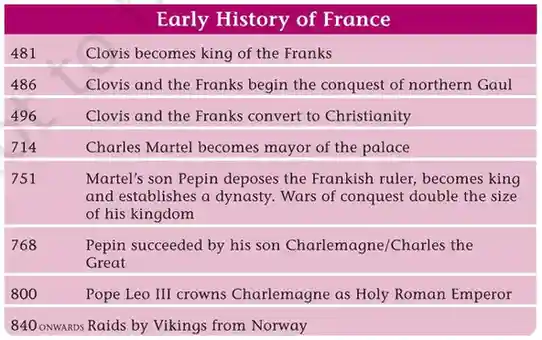
- The Franks were a Germanic tribe.
- They gave their name to Gaul.
- Gaul came to be known as ‘France’.
3. Formation of the Frankish Kingdom:
- From the sixth century, Gaul became a kingdom.
- It was ruled by Frankish or French kings.
- These rulers were Christian.
4. Relationship with the Church:
- The French rulers had strong links with the Church.
- These ties became stronger over time.
5. Charlemagne and the Papacy:
- In 800, the Pope conferred the title of ‘Holy Roman Emperor’ on King Charlemagne.
- This was done to ensure Charlemagne’s support.
6. England–Scotland and Norman Conquest:
- Across a narrow channel lay the island of England–Scotland.
- In the eleventh century, it was conquered by a duke from Normandy.
- Normandy was a French province.
Next & Previous Topics of NCERT/CBSE History Class 11 Chapter 4: The Three Orders
MCQs on NCERT History Class 11 Chapter 4 Topic – France and England Class 11
Here are the top exam-oriented MCQ-type questions on “France and England Class 11” that you should prepare for your CBSE or state board exams:
Question 1. Gaul was a province of the:
a) Byzantine Empire
b) Roman Empire
c) Ottoman Empire
d) Persian Empire
Answer: b) Roman Empire
Question 2. Which geographical features of Gaul made it suitable for agriculture?
a) Deserts and plateaus
b) Dense cities and ports
c) Plains, rivers and forests
d) Volcanic soil and glaciers
Answer: c) Plains, rivers and forests
Question 3. Gaul had how many extensive coastlines?
a) One
b) Two
c) Three
d) Four
Answer: b) Two
Question 4. The tribe that gave its name to Gaul, making it ‘France’, was the:
a) Goths
b) Saxons
c) Franks
d) Lombards
Answer: c) Franks
Question 5. The Franks were originally a:
a) Roman tribe
b) Celtic tribe
c) Germanic tribe
d) Slavic tribe
Answer: c) Germanic tribe
Question 6. From which century did Gaul become a kingdom ruled by Frankish kings?
a) Fourth century
b) Fifth century
c) Sixth century
d) Seventh century
Answer: c) Sixth century
Question 7. The Frankish/French kings were followers of:
a) Paganism
b) Islam
c) Judaism
d) Christianity
Answer: d) Christianity
Question 8. The French kings had strong links with which institution?
a) The Roman Senate
b) The Church
c) The Army
d) Merchant guilds
Answer: b) The Church
Question 9. In 800, the Pope gave Charlemagne the title of:
a) King of the Franks
b) Emperor of Gaul
c) Holy Roman Emperor
d) Defender of the Faith
Answer: c) Holy Roman Emperor
Question 10. The Pope granted Charlemagne the imperial title mainly to:
a) Expand trade
b) Spread Christianity
c) Ensure his political support
d) Control England
Answer: c) Ensure his political support
Question 11. England–Scotland is separated from Gaul by a:
a) Wide sea
b) Large gulf
c) Narrow channel
d) River
Answer: c) Narrow channel
Question 12. In the eleventh century, England–Scotland was conquered by a duke from:
a) Brittany
b) Aquitaine
c) Normandy
d) Burgundy
Answer: c) Normandy