
A Trading Town in a Pastoral Zone Class 11 – Concept, MCQs & Notes PDF
Topic covered: A Trading Town in a Pastoral Zone class 11 notes and MCQs questions: Writing and City Life (All single detail notes are exam-oriented).
We have discussed in-depth and exam-oriented pointers that can be asked in the board exam of class 11th about “A Trading Town in a Pastoral Zone“ from the NCERT history notes for class 11th chapter 1 Writing and City Life.
Download the NCERT History for Class 11th Chapter 1 Writing and City Life Notes PDF
Chapter 1 of Class 11 History, Writing and City Life, takes you into the early world of Mesopotamia, where writing first appeared, and cities began to shape human life in new ways. Students often find the connection between trade, administration, and the development of writing a bit overwhelming, so these notes break everything into clear, story-like sections. You’ll understand how cities grew, why records became essential, and how everyday life looked in the earliest civilisations. If you want a simple, exam-friendly guide, you can download the NCERT History for Class 11th Chapter 1 Writing and City Life Notes PDF and revise with ease.
A Trading Town in a Pastoral Zone
1. Location and Growth of Mari:
- Mari flourished after 2000 BCE as a major royal capital.
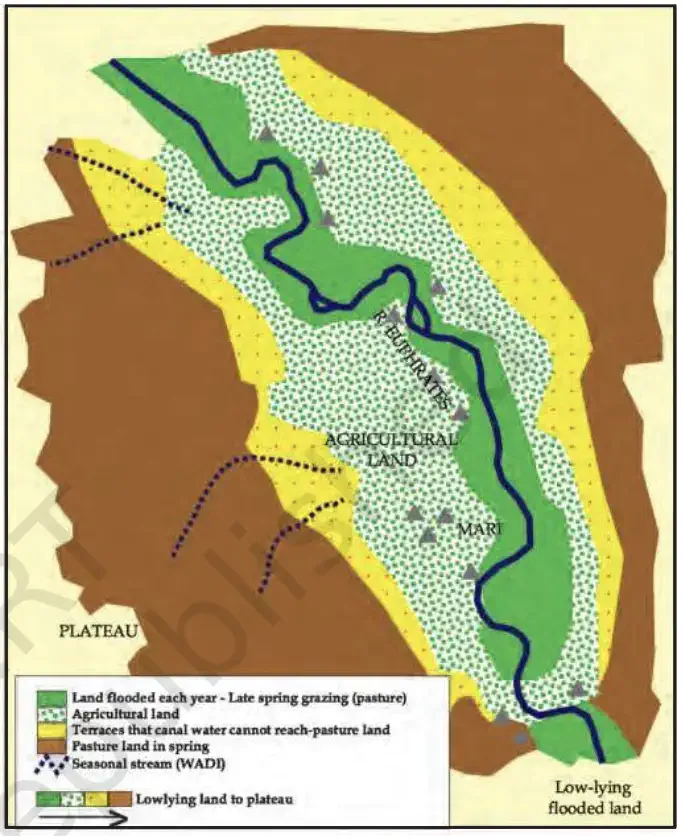
- It was located upstream on the Euphrates, away from the southern agricultural plain.
- The region had both farming and pastoral zones situated close to each other.
2. Farming–Pastoral Relations:
- Some communities combined farming and pastoralism, but most land in Mari was used for grazing sheep and goats.
- Pastoralists exchanged animals, cheese, leather, and meat for grain and metal tools.
- Manure from flocks was valuable for farmers.
- Conflicts occurred when flocks damaged crops or when herders raided villages.
- Settled groups sometimes blocked pastoralists’ access to river and canal water.
3. Movement of Nomadic Groups:
- Nomadic groups from the western desert frequently entered agricultural regions.
- Shepherds brought their flocks into sown areas during summer.
- These groups came as herders, harvest labourers or hired soldiers, and some settled permanently.
- Some became powerful and founded ruling dynasties such as the Akkadians, Amorites, Assyrians and Aramaeans.
4. Kings and Culture of Mari:
- The kings of Mari were Amorites with distinct dress from earlier inhabitants.
- They respected Mesopotamian gods and built a temple for Dagan, god of the steppe.
- Mesopotamian society absorbed diverse cultures, adding to its vitality.
5. Control Over Pastoral Communities:
- Herders were allowed movement within the kingdom but were closely watched.
- Letters mention frequent fire signals between herder camps, raising suspicion of planned raids.
6. Mari as a Trade Centre:
- Mari’s position on the Euphrates made it ideal for trade between southern Mesopotamia and regions like Turkey, Syria and Lebanon.
- Goods traded included wood, copper, tin, oil, wine and other items transported by river boats.
- Boats stopped at Mari for inspection; officials levied a tax of about one-tenth the cargo’s value.
- Barley was carried in special grain boats.
- Copper from Alashiya (Cyprus) and tin were major trade items.
- Bronze, made from copper and tin, was essential for tools and weapons.
7. Prosperity of Mari:
- Despite limited military strength, Mari became exceptionally prosperous due to trade.
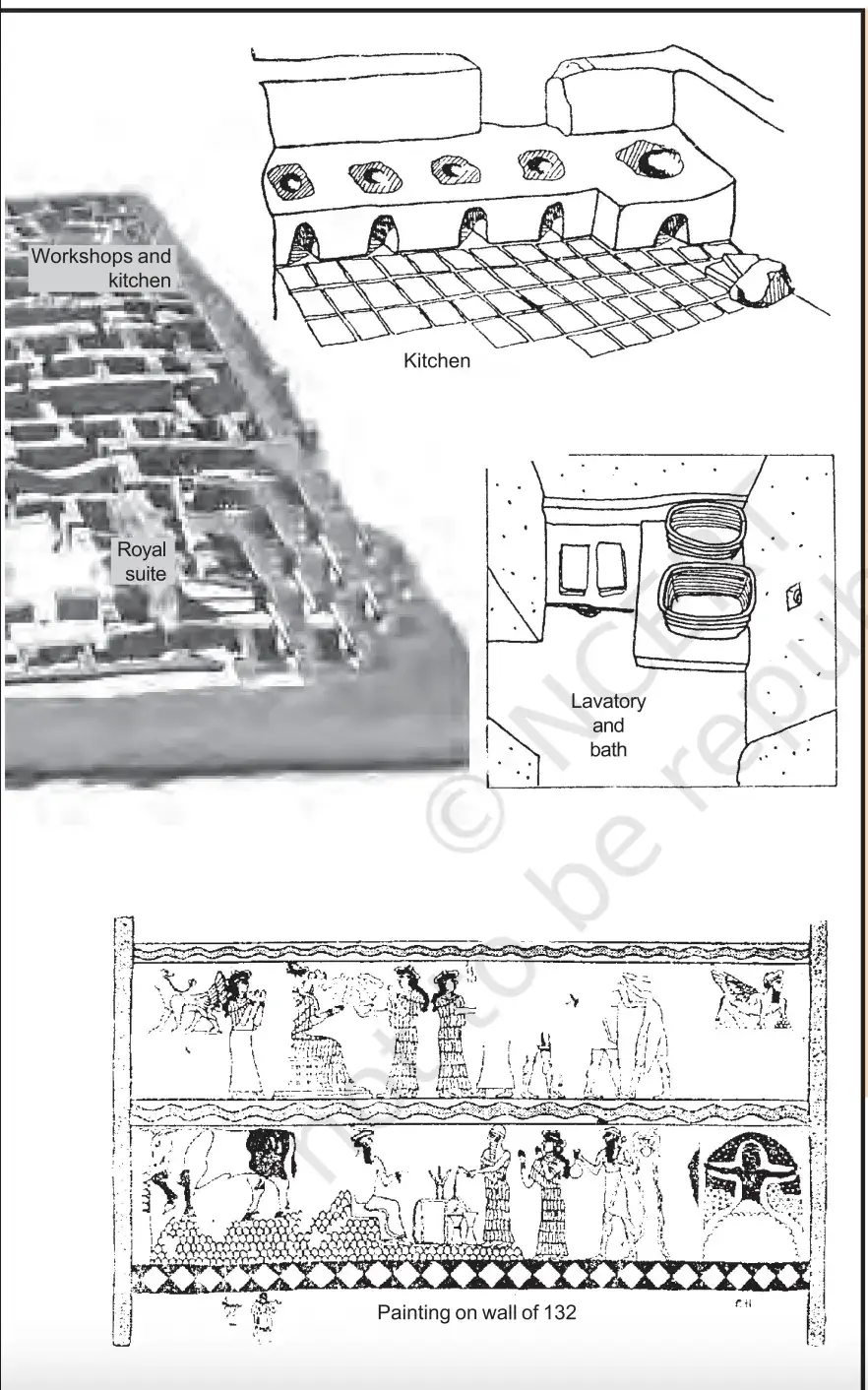
The Palace at Mari of King Zimrilim (1810-1760 BCE)
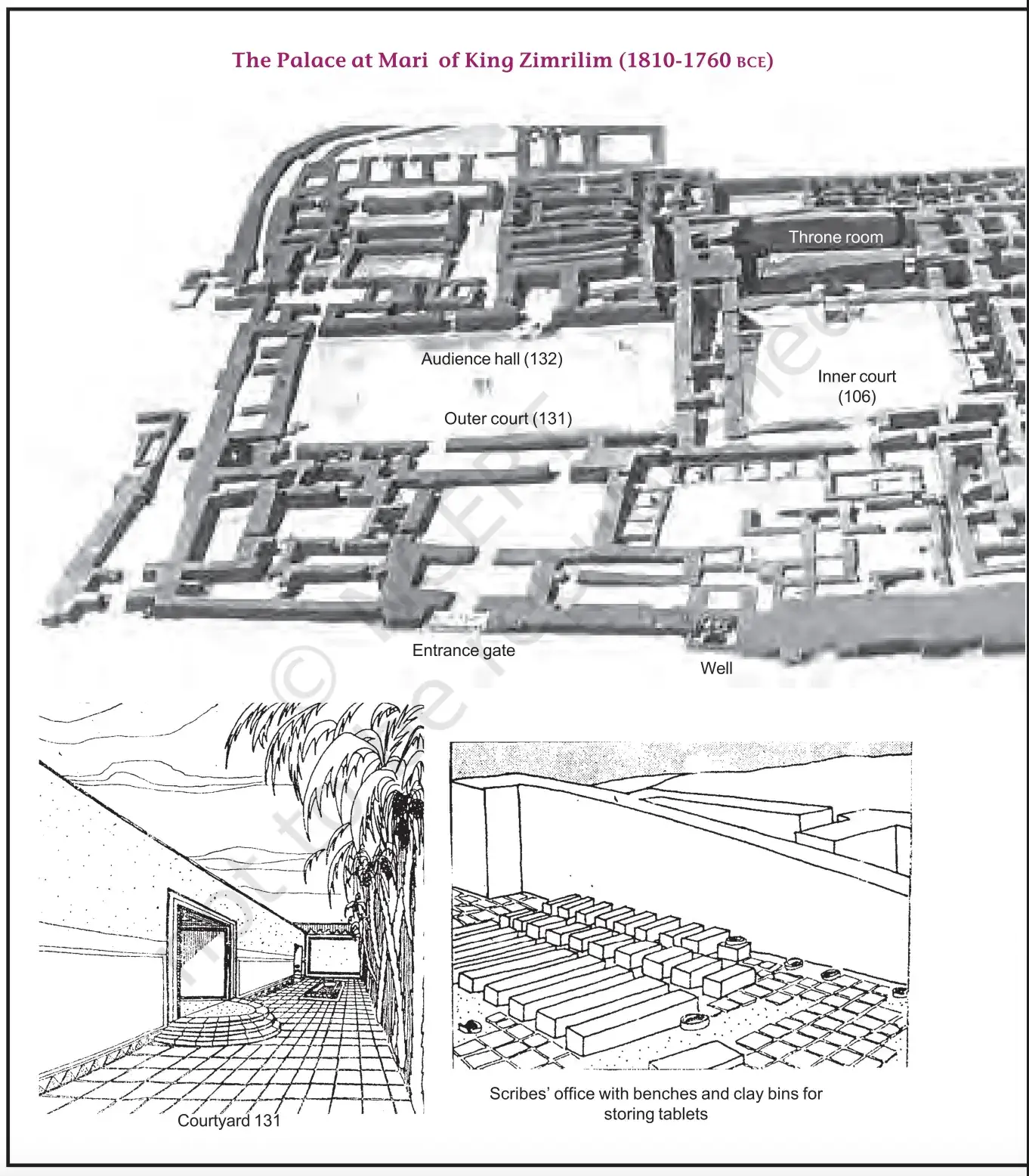
- The palace at Mari served as the residence of the royal family.
- It was also the main center of administration in the kingdom.
- The palace functioned as a production hub, especially for precious metal ornaments.
- Its fame was so great that a minor king travelled from north Syria only to see it.
- He carried a letter of introduction from a royal friend of King Zimrilim.
- Daily records show huge quantities of food supplied for the king: flour, bread, meat, fish, fruit, beer and wine.
- The king likely dined with many others in or around courtyard 106, which was paved in white.
- The palace had a single entrance located on the north side.
- Large courtyards like courtyard 131 were beautifully paved.
- Foreign dignitaries and local people were received in room 132.
- Room 132 had impressive wall paintings meant to awe visitors.
- The palace was extremely large, containing 260 rooms.
- It covered a total area of 2.4 hectares.
Excavating Mesopotamian Towns
1. Modern Excavation Practices:
- Present-day Mesopotamian excavators follow far higher standards of accuracy and care.
- Large-scale excavations like those once done at Ur are now rare.
- Limited funds prevent archaeologists from hiring large excavation teams.
- As a result, the method of collecting data has changed significantly.
2. Excavation at Abu Salabikh:
- Abu Salabikh was a small town of about 10 hectares in 2500 BCE.
- Its population was less than 10,000.
- Excavators first traced wall outlines by scraping the surface of the mound.
- Scraping removed only a few millimetres of soil using a shovel’s sharp and wide edge.
- Moist soil beneath revealed different colours, textures and lines indicating walls, pits, and other features.
3. Discoveries Through Excavation:
- A few houses were uncovered and excavated.
- Tons of earth were sieved to recover plant and animal remains.
- Archaeologists identified several species of plants and animals.
- Large amounts of charred fish bones were found in the streets, showing they had been swept out of homes.
- Plant seeds and fibre left after burning dung cakes helped identify kitchen areas.
- Rooms with fewer traces were marked as living rooms.
4. Evidence of Animal Life:
- Teeth of very young pigs found on the streets indicate pigs roamed freely in the town.
- A house burial containing pig bones suggests pork was provided as food for the dead in the afterlife.
5. Studying House Structures:
- Microscopic analysis of room floors helped determine which rooms were roofed.
- Materials used for roofing included poplar logs, palm leaves, and straw.
- Rooms without roofing were identified as open to the sky.
Summary of A Trading Town in a Pastoral Zone Class 11
Mari grew into a major trading town after 2000 BCE, even though most of its land was pastoral. Farmers and herders lived side by side, sometimes cooperating through exchange and sometimes clashing over fields, water, and raids. Nomadic groups from the western desert often entered the region, and some—like the Amorites—rose to power and shaped Mari’s culture. The town thrived because of its position on the Euphrates, where boats carrying wood, wine, copper, tin, and grain stopped to pay taxes before moving south. This trade made Mari wealthy despite its limited military strength. Excavations at sites like Abu Salabikh reveal how archaeologists uncover daily life through careful tracing of walls, studying floors, and analysing plant, animal, and household remains.
Next & Previous Topics of NCERT/CBSE History Class 11 Chapter 1: Writing and City Life
MCQs on NCERT History Class 11 Chapter 1 Topic – A Trading Town in a Pastoral Zone Class 11 Notes
Here are the top exam-oriented MCQ-type questions on “A Trading Town in a Pastoral Zone Class 11 Notes” that you should prepare for your CBSE or state board exams:
Question 1. After 2000 BCE, the royal capital that flourished was
a) Uruk
b) Mari
c) Kish
d) Babylon
Answer: b
Question 2. Mari was located
a) On the southern alluvial plain
b) Far upstream on the Euphrates
c) On the Tigris delta
d) Near the Zagros mountains
Answer: b
Question 3. Most of Mari’s territory was used for
a) Growing wheat
b) Mining gold
c) Pasturing sheep and goats
d) Fishing
Answer: c
Question 4. Pastoralists from Mari often exchanged their products for
a) Spices
b) Grain and metal tools
c) Stone beads
d) Precious stones
Answer: b
Question 5. Manure from penned flocks was important to
a) Priests
b) Traders
c) Farmers
d) Soldiers
Answer: c
Question 6. One major cause of conflict between farmers and herders was
a) Temple taxes
b) Weather
c) Flocks damaging sown fields
d) Lack of drinking water
Answer: c
Question 7. Settled groups sometimes tried to restrict pastoralists’ access to
a) Roads
b) Markets
c) River and canal water
d) Palaces
Answer: c
Question 8. Nomadic groups entering Mesopotamia often came from
a) Eastern mountains
b) Western desert
c) Southern marshlands
d) Northern forests
Answer: b
Question 9. Many nomadic groups entered the sown area, especially in
a) Winter
b) Monsoon
c) Summer
d) Spring
Answer: c
Question 10. Some pastoral groups eventually became rulers, including
a) Sumerians
b) Akkadians and Amorites
c) Minoans
d) Spartans
Answer: b
Question 11. Which group did the kings of Mari belong to?
a) Assyrians
b) Amorites
c) Aramaeans
d) Akkadians
Answer: b
Question 12. The kings of Mari built a temple dedicated to
a) Enlil
b) Dagan
c) Nanna
d) Marduk
Answer: b
Question 13. Mari’s cultural life shows that Mesopotamian society was
a) Closed
b) Hostile
c) Open to migrants and diverse cultures
d) Militaristic
Answer: c
Question 14. The kings of Mari allowed herders to enter the kingdom, but
a) They had to pay a tax
b) Only during winter
c) They were closely watched
d) They needed a priest’s approval
Answer: c
Question 15. Frequent night fire signals between herder camps indicated
a) Religious rituals
b) Weather warnings
c) A possible raid or attack
d) Trade plans
Answer: c
Question 16. Mari prospered mainly because of
a) Military power
b) Rich agriculture
c) Trade
d) Iron production
Answer: c
Question 17. Goods traded through Mari included
a) Iron and silk
b) Spices and ivory
c) Wood, copper, tin, oil, wine
d) Gold and diamonds
Answer: c
Question 18. Mari lay on a major trade route between the south and
a) Iran
b) Mineral-rich uplands of Turkey, Syria, and Lebanon
c) Egypt
d) Arabia
Answer: b
Question 19. Officers at Mari inspected cargo on boats and charged about
a) One-fourth
b) One-half
c) One-tenth
d) One-sixth
Answer: c
Question 20. A single river boat reaching Mari could carry around
a) 50 jars of wine
b) 150 jars
c) 300 jars
d) 500 jars
Answer: c
Question 21. “Alashiya,” frequently mentioned on tablets, refers to
a) Egypt
b) Cyprus
c) Lebanon
d) Crete
Answer: b
Question 22. Copper from Alashiya and tin were vital because
a) They made jewellery
b) They were used for bronze
c) They were traded for wheat
d) They were temple offerings
Answer: b
Question 23. Bronze was the primary material for
a) Clothing
b) Tools and weapons
c) Boat building
d) Palace flooring
Answer: b
Question 24. Although Mari lacked military strength, it was
a) Poor
b) Isolated
c) Exceptionally prosperous
d) Abandoned
Answer: c
Question 25. The great palace of Mari belonged to
a) Zimrilim
b) Hammurabi
c) Gudea
d) Sargon
Answer: a
Question 26. The palace served as a royal residence and also as a
a) School
b) Temple centre
c) Hub of administration and production
d) Military camp
Answer: c
Question 27. The palace produced mainly
a) Textiles
b) Pottery
c) Precious metal ornaments
d) Weapons
Answer: c
Question 28. A minor king from north Syria once visited the palace
a) Secretly
b) With a letter of introduction
c) As a prisoner
d) For a trade meeting
Answer: b
Question 29. Daily food lists from the palace show
a) Scarcity of food
b) Vegetarian meals
c) Huge quantities of food were prepared
d) Only bread and beer were consumed
Answer: c
Question 30. The king often ate with others in or near
a) Courtyard 106
b) Room 12
c) Terrace 5
d) Hall 200
Answer: a
Question 31. The palace had only one entrance, located on the
a) East
b) West
c) South
d) North
Answer: d
Question 32. The palace covered an area of
a) 1 hectare
b) 2.4 hectares
c) 10 hectares
d) 15 hectares
Answer: b
Question 33. The number of rooms in the palace was around
a) 50
b) 120
c) 260
d) 400
Answer: c
Question 34. Modern excavators avoid digging huge areas mainly because
a) It damages soil
b) They follow higher standards and lack large funds
c) Local laws forbid it
d) It is too dangerous
Answer: b
Question 35. Abu Salabikh was about 10 hectares in
a) 3000 BCE
b) 2500 BCE
c) 1500 BCE
d) 500 BCE
Answer: b
Question 36. The population of Abu Salabikh was
a) Below 5000
b) Under 10,000
c) About 25,000
d) Over 50,000
Answer: b
Question 37. Archaeologists traced wall outlines by
a) Digging trenches
b) Flooding the site
c) Scraping the surface carefully
d) Burning the topsoil
Answer: c
Question 38. Different soil colours and textures helped identify
a) Gold deposits
b) River channels
c) Brick walls and pits
d) Fossils
Answer: c
Question 39. Archaeologists recovered plant and animal remains by
a) Washing stones
b) Farming the land
c) Sieving large amounts of earth
d) Using metal detectors
Answer: c
Question 40. Large quantities of charred fish bones found on the streets revealed
a) Lack of food
b) Fishing was banned
c) Fish was a common food
d) Houses were near rivers
Answer: c
Question 41. Seeds and fibres remaining after dung cakes burned helped identify
a) Bedrooms
b) Kitchens
c) Herding camps
d) Storage rooms
Answer: b
Question 42. Rooms with fewer traces of burning were identified as
a) Storerooms
b) Workshops
c) Living rooms
d) Shrines
Answer: c
Question 43. Teeth of very young pigs found on the streets suggested that
a) Pigs were hunted
b) Pigs roamed freely
c) People avoided pork
d) Pigs were kept in royal pens
Answer: b
Question 44. Pig bones found in a house burial imply
a) Pigs were sacred
b) Pork was offered for afterlife nourishment
c) Burial rituals changed
d) Pigs were enemies
Answer: b
Question 45. Microscopic floor studies helped determine
a) Weather patterns
b) Trading routes
c) Which rooms were roofed or open
d) Social structure
Answer: c
Nice resource