

Topic & sub-topics covered: The Peculiarities of Industrial Growth, Small-scale Industries Predominate: The Age of Industrialisation (All single detail notes are exam-oriented).
We have discussed in-depth and exam-oriented pointers that can be asked in the board exam of class 10th about “The Peculiarities of Industrial Growth, Small-scale Industries Predominate” which is taken from the NCERT History book for class 10th chapter no. 4 “The Age of Industrialisation“.
Download NCERT History Chapter 4 Class 10th Notes PDF for The Age of Industrialisation
If you are in class 10th and looking for free NCERT History chapter 4 notes of the chapter The Age of Industrialisation class 10 that cover concepts, then you can download the free class 10th History chapter 4 notes “The Age of Industrialisation”. You should download this free PDF for future test or exam preparations.
The Peculiarities of Industrial Growth
1. European Managing Agencies:
- Dominated industrial production in India.
- Invested in tea, coffee plantations, mining, indigo, and jute for export trade.
2. Indian Industrial Beginnings:
- Indian businessmen, in the late 19th century, avoided competing with Manchester goods in the Indian market.
- Early cotton mills produced coarse cotton yarn rather than fabric.
3. Yarn Production and Export:
- Yarn produced in Indian spinning mills was primarily used by handloom weavers in India or exported to China.
- Superior quality yarn was imported.
4. Changes in Industrialization (Early 20th Century):
- Swadeshi movement and nationalist efforts led to changes in industrial patterns.
- Industrialists shifted from yarn to cloth production due to declining exports to China.
5. Impact of World War I:
- During World War I, British mills focused on war production, reducing Manchester imports into India.
- Indian mills had a vast home market as a result.
- Industrial production boomed, and new factories were established.
6. Post-War Industrial Scenario:
- Manchester struggled to regain its position in the Indian market after the war.
- Britain’s economic decline post-war contributed to the fall in cotton production and cloth exports.
7. Post-War Indian Industrial Growth:
- Local industrialists in the colonies, including India, consolidated their position.
- They substituted foreign manufacturers and captured the home market.
These pointers cover the dominance of European Managing Agencies, the early Indian industrial scenario, changes in industrialization, the impact of World War I, and the subsequent growth of Indian industries.
Small-scale Industries Predominate
1. Post-War Industrial Growth:
- Factory industries grew steadily after World War I.
- Large industries constituted a small segment of the economy.
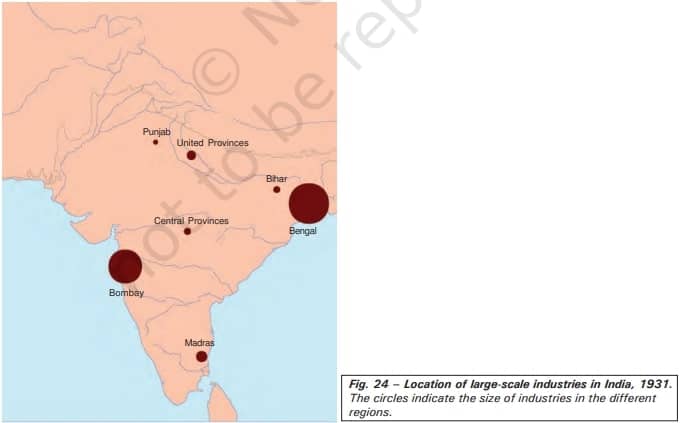
2. Industrial Distribution (1911):
- Approximately 67% of large industries were concentrated in Bengal and Bombay in 1911.
- Small-scale production dominated the rest of the country.
3. Composition of Industrial Labor Force:
- A small proportion of the industrial labour force worked in registered factories: 5% in 1911 and 10% in 1931.
- The majority worked in small workshops and household units.
4. Continuation of Small-Scale Production:
- Small-scale production continued to predominate in various regions.
- Many units were located in alleys and bylanes, often unseen by passers-by.
5. Expansion of Handloom Cloth Production:
- Handloom cloth production almost tripled between 1900 and 1940.
- The adoption of new technology, such as fly shuttles, contributed to increased productivity.
6. Technological Changes in the Handloom Sector:
- Weavers adopted technological changes like looms with a fly shuttle.
- By 1941, over 35% of handlooms in India were fitted with fly shuttles, reaching 70-80% in specific regions.
7. Survival Strategies of Weavers:
- Weavers producing finer varieties were in a better position to survive competition with mill industries.
- Specialized weaves like Banarasi or Baluchari saris couldn’t be easily imitated by mills.
8. Impact of Famine on Cloth Demand:
- Coarse cloth demand fluctuated violently, especially during bad harvests and famines.
- Finer varieties had a more stable demand as the rich could afford them even during tough times.
9. Challenges and Resilience:
- Weavers and craftspeople faced hardships and long working hours.
- Their lives were integral to the process of industrialization, not just remnants of the past.
These exam-oriented pointers cover the distribution of industries, the composition of the labour force, the continuation of small-scale production, the expansion of handloom cloth production, technological changes, the survival strategies of weavers, and the challenges they face.
Next & Previous Topics of NCERT/CBSE History Class 10 Chapter 4: The Age of Industrialisation
FAQ
Q1. How did European Managing Agencies impact industrial production in India?
Answer: European Managing Agencies dominated industrial production, investing in tea, coffee plantations, mining, indigo, and jute for export trade.
Q2. What characterized the beginnings of Indian industrialization?
Answer: Indian businessmen, in the late 19th century, avoided competing with Manchester goods in the Indian market. Early cotton mills produced coarse cotton yarn rather than fabric.
Q3: How did the Swadeshi movement affect industrial patterns in India?
Answer: The Swadeshi movement and nationalist efforts led to changes in industrial patterns. Industrialists shifted from yarn to cloth production due to declining exports to China.
MCQs on NCERT History Class 10 Chapter 4 – The Peculiarities of Industrial Growth Class 10
Here are the top exam-oriented MCQ-type questions on “The Peculiarities of Industrial Growth Class 10” that you should prepare for your CBSE or state board exams:
Question 1. Who dominated industrial production in India during the early phase of industrial growth?
A) Indian peasants
B) European Managing Agencies
C) Local artisans
D) Government officials
Answer: B
Question 2. European Managing Agencies mainly invested in:
A) Education and health
B) Tea, coffee, mining, indigo, and jute
C) Railways only
D) Banking sector
Answer: B
Question 3. In the late 19th century, Indian businessmen mainly avoided:
A) Exporting goods
B) Competing with Manchester goods
C) Producing yarn
D) Trading with China
Answer: B
Question 4. Early Indian cotton mills mainly produced:
A) Fine cloth
B) Silk
C) Coarse cotton yarn
D) Wool
Answer: C
Question 5. Indian yarn was primarily used by:
A) European factories
B) Indian handloom weavers and exported to China
C) Government industries
D) Only for local markets
Answer: B
Question 6. What caused Indian industrialists to shift from yarn to cloth production?
A) Government orders
B) Decline in exports to China
C) Increase in imports
D) Lack of labour
Answer: B
Question 7. Which movement influenced industrial changes in the early 20th century?
A) Quit India Movement
B) Swadeshi Movement
C) Non-Cooperation Movement
D) Civil Disobedience Movement
Answer: B
Question 8. During World War I, British mills focused on:
A) Textile exports
B) War production
C) Agriculture
D) Trade with India
Answer: B
Question 9. What was the impact of World War I on Indian industries?
A) Decline in production
B) No change
C) Industrial boom and new factories
D) Closure of mills
Answer: C
Question 10. After World War I, Manchester struggled to:
A) Produce yarn
B) Regain its position in the Indian market
C) Export goods to China
D) Control colonies
Answer: B
Question 11. Post-war, Indian industrialists:
A) Lost the market
B) Depended on imports
C) Captured the home market
D) Closed factories
Answer: C
Question 12. After World War I, factory industries in India:
A) Declined rapidly
B) Remained stagnant
C) Grew steadily
D) Were banned
Answer: C
Question 13. In 1911, about 67% of large industries were located in:
A) Delhi and Punjab
B) Bengal and Bombay
C) Madras and Mysore
D) Bihar and Orissa
Answer: B
Question 14. In 1911, what percentage of industrial labour worked in registered factories?
A) 2%
B) 5%
C) 10%
D) 20%
Answer: B
Question 15. By 1931, factory labour increased to:
A) 8%
B) 10%
C) 15%
D) 20%
Answer: B
Question 16. Most industrial workers were employed in:
A) Large factories
B) Government offices
C) Small workshops and household units
D) Foreign industries
Answer: C
Question 17. Handloom cloth production between 1900 and 1940:
A) Declined
B) Remained constant
C) Doubled
D) Almost tripled
Answer: D
Question 18. Which technological innovation improved handloom productivity?
A) Steam engine
B) Power loom
C) Fly shuttle
D) Spinning jenny
Answer: C
Question 19. Which type of weavers survived better during industrial competition?
A) Coarse cloth producers
B) Machine operators
C) Fine quality weavers (e.g., Banarasi)
D) Foreign traders
Answer: C
Question 20. Demand for coarse cloth during famines:
A) Increased steadily
B) Remained stable
C) Fluctuated violently
D) Disappeared completely
Answer: C